a shipping box can carry no more than 6 pounds. each order of jumbo paperclips weighs 2 pounds, and each…
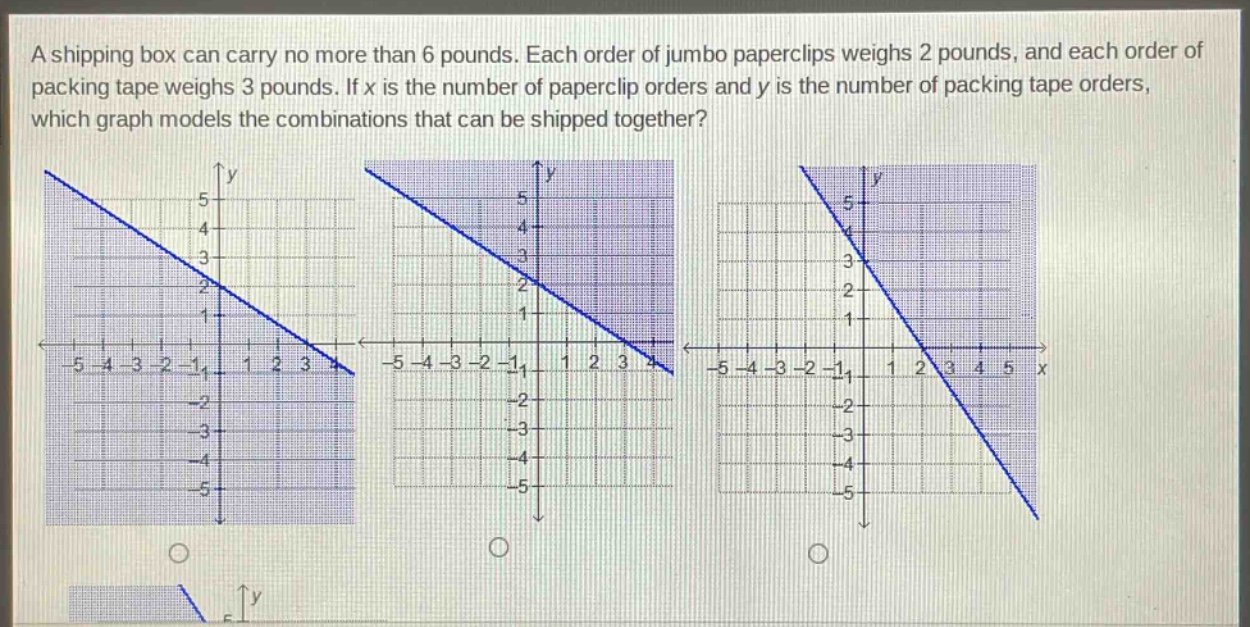
a shipping box can carry no more than 6 pounds. each order of jumbo paperclips weighs 2 pounds, and each order of packing tape weighs 3 pounds. if x is the number of paperclip orders and y is the number of packing tape orders, which graph models the combinations that can be shipped together?
Answer
Answer:
The inequality representing the situation is (2x + 3y\leq6), where (x\geq0) and (y\geq0) (since the number of orders cannot be negative). To graph (2x + 3y\leq6), first find the x - intercept and y - intercept. For the x - intercept, set (y = 0): [2x+3\times0=6\Rightarrow x = 3] For the y - intercept, set (x = 0): [2\times0+3y=6\Rightarrow y = 2] The line (2x + 3y=6) passes through the points ((3,0)) and ((0,2)). Since the inequality is (\leq), the region below (and including) the line (2x + 3y = 6) in the first - quadrant (because (x\geq0,y\geq0)) is the solution set.
Explanation:
Step1: Form the inequality
The weight of paperclip orders is (2x) pounds and of packing - tape orders is (3y) pounds. The total weight must be no more than 6 pounds, so (2x + 3y\leq6). Also, (x\geq0) and (y\geq0) as the number of orders can't be negative.
Step2: Find x - intercept
Set (y = 0) in (2x+3y = 6). We get (2x=6), so (x = 3). The line crosses the x - axis at ((3,0)).
Step3: Find y - intercept
Set (x = 0) in (2x + 3y=6). We get (3y=6), so (y = 2). The line crosses the y - axis at ((0,2)).
Step4: Determine the solution region
Since the inequality is (2x + 3y\leq6), we shade the region below (and including) the line (2x + 3y = 6) in the first - quadrant (due to (x\geq0,y\geq0)).