a shoe store owner is designing the layout of the displays in his store. the floor area for the store is…
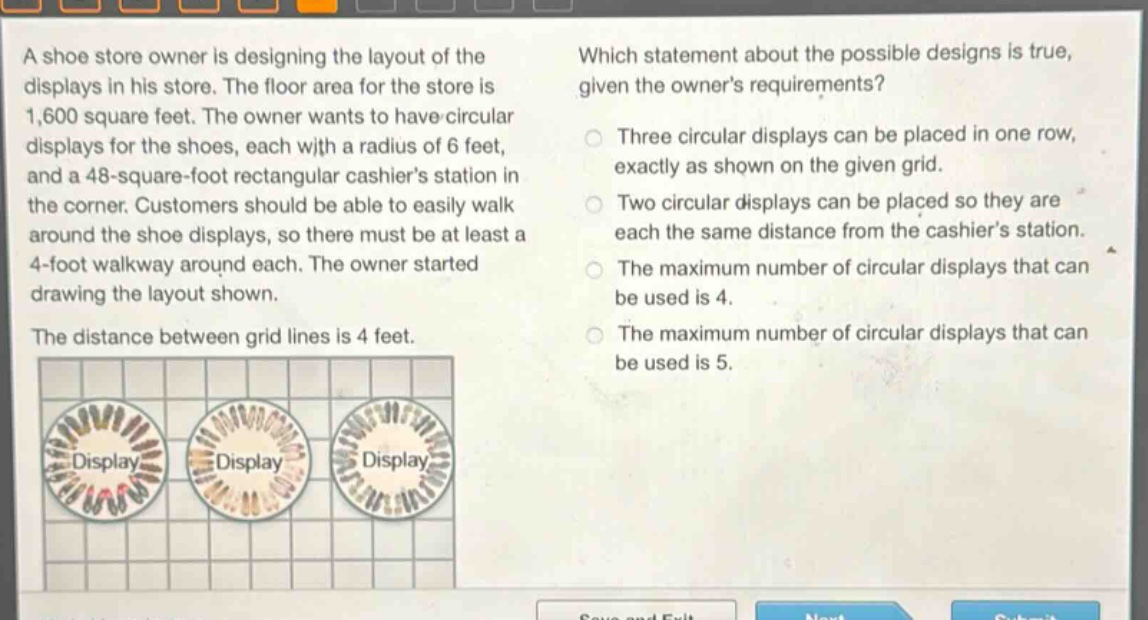
a shoe store owner is designing the layout of the displays in his store. the floor area for the store is 1,600 square feet. the owner wants to have circular displays for the shoes, each with a radius of 6 feet, and a 48 - square - foot rectangular cashiers station in the corner. customers should be able to easily walk around the shoe displays, so there must be at least a 4 - foot walkway around each. the owner started drawing the layout shown. the distance between grid lines is 4 feet. which statement about the possible designs is true, given the owners requirements? three circular displays can be placed in one row, exactly as shown on the given grid. two circular displays can be placed so they are each the same distance from the cashiers station. the maximum number of circular displays that can be used is 4. the maximum number of circular displays that can be used is 5.
Answer
Answer:
The maximum number of circular displays that can be used is 4.
Explanation:
Step1: Calculate diameter of display
The diameter $d$ of a circular display with radius $r = 6$ feet is $d=2r = 12$ feet. With a 4 - foot walkway around each, the total width per display unit is $12 + 4+4=20$ feet.
Step2: Analyze row - placement
If we consider placing displays in a row, assume the length of the store allows for placement. But we also need to consider the available area. The area of each circular display is $A=\pi r^{2}=\pi\times6^{2}=36\pi\approx113.1$ square feet.
Step3: Consider available area
The total floor area is 1600 square feet and the cashier's station takes 48 square feet. So the available area for displays is $1600 - 48=1552$ square feet.
Step4: Calculate number of displays
If we assume we try to place as many displays as possible. Let's consider the space - usage. If we place 5 displays, the total area they would occupy (ignoring just the circular area and considering the space with walkways) would be too large for the available area. If we place 4 displays, we can manage the space within the available area and also meet the walk - way requirements. So the maximum number of circular displays that can be used is 4.