short response\n31. given that cos θ = -0.25 and tan θ > 0, what is sin θ? round to the nearest…
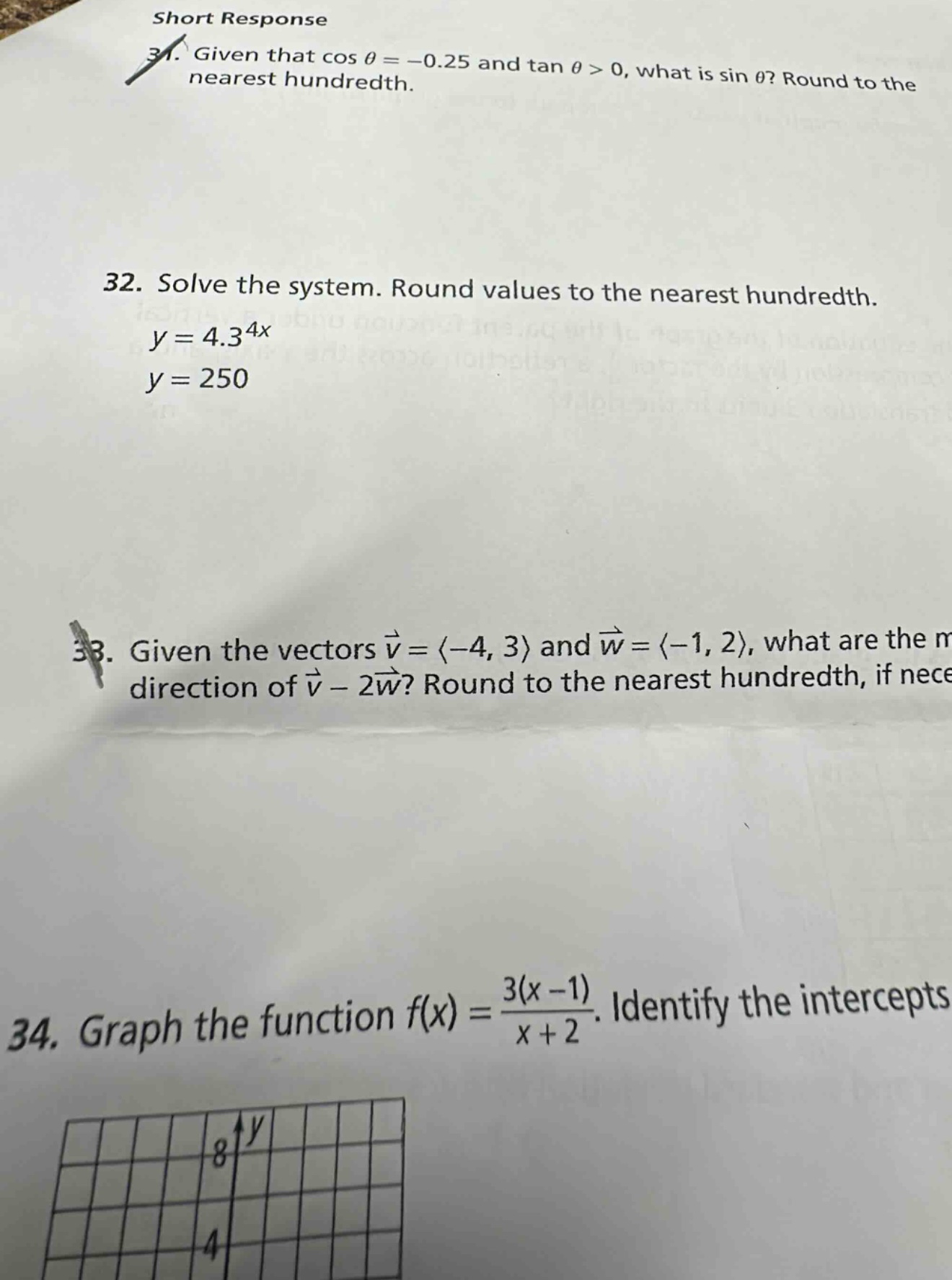
short response\n31. given that cos θ = -0.25 and tan θ > 0, what is sin θ? round to the nearest hundredth.\n32. solve the system. round values to the nearest hundredth.\ny = 4.3^{4x}\ny = 250\n33. given the vectors $vec{v}=langle - 4,3\rangle$ and $vec{w}=langle - 1,2\rangle$, what are the magnitude and direction of $vec{v}-2vec{w}$? round to the nearest hundredth, if necessary.\n34. graph the function $f(x)=\frac{3(x - 1)}{x + 2}$. identify the intercepts
Answer
31.
Explanation:
Step1: Determine the quadrant
Since $\cos\theta=- 0.25<0$ and $\tan\theta > 0$, $\theta$ is in the third - quadrant, and $\sin\theta<0$.
Step2: Use the Pythagorean identity
We know that $\sin^{2}\theta+\cos^{2}\theta = 1$. So $\sin^{2}\theta=1 - \cos^{2}\theta$. Substitute $\cos\theta=-0.25$ into the formula: $\sin^{2}\theta=1-(-0.25)^{2}=1 - 0.0625 = 0.9375$.
Step3: Solve for $\sin\theta$
Since $\sin\theta<0$ in the third - quadrant, $\sin\theta=-\sqrt{0.9375}\approx - 0.97$.
Answer:
$-0.97$
32.
Explanation:
Step1: Set the two equations equal
Since $y = 4.3^{4x}$ and $y = 250$, we set $4.3^{4x}=250$.
Step2: Take the natural logarithm of both sides
$\ln(4.3^{4x})=\ln(250)$. Using the property $\ln(a^{b})=b\ln(a)$, we get $4x\ln(4.3)=\ln(250)$.
Step3: Solve for $x$
$x=\frac{\ln(250)}{4\ln(4.3)}$. Calculate $\ln(250)\approx5.52146$, $\ln(4.3)\approx1.45862$. Then $4\ln(4.3)\approx5.83448$. So $x=\frac{5.52146}{5.83448}\approx0.95$.
Answer:
$x\approx0.95$
33.
Explanation:
Step1: Calculate $\vec{v}-2\vec{w}$
First, find $2\vec{w}=2\langle - 1,2\rangle=\langle - 2,4\rangle$. Then $\vec{v}-2\vec{w}=\langle - 4,3\rangle-\langle - 2,4\rangle=\langle - 4+2,3 - 4\rangle=\langle - 2,-1\rangle$.
Step2: Find the direction (angle $\theta$)
The formula for the direction of a vector $\langle x,y\rangle$ is $\tan\theta=\frac{y}{x}$. Here $x=-2$ and $y = - 1$, so $\tan\theta=\frac{-1}{-2}=0.5$. Since the vector $\langle - 2,-1\rangle$ is in the third - quadrant, $\theta=\arctan(0.5)+\pi$. $\arctan(0.5)\approx0.4636$ radians, so $\theta\approx0.4636+\pi\approx3.60$ radians or $\theta\approx206.57^{\circ}$.
Answer:
$\theta\approx206.57^{\circ}$
34.
Explanation:
Step1: Find the $x$ - intercept
Set $y = 0$. Then $\frac{3(x - 1)}{x + 2}=0$. This implies $3(x - 1)=0$ (since the denominator cannot be zero for the function to be zero), so $x = 1$. The $x$ - intercept is $(1,0)$.
Step2: Find the $y$ - intercept
Set $x = 0$. Then $y=\frac{3(0 - 1)}{0+2}=-\frac{3}{2}$. The $y$ - intercept is $(0,-\frac{3}{2})$.
Step3: Analyze the vertical asymptote
Set the denominator equal to zero: $x + 2=0$, so $x=-2$ is the vertical asymptote.
Step4: Analyze the horizontal asymptote
Since the degree of the numerator and the denominator are the same (both degree 1), the horizontal asymptote is $y=\frac{3}{1}=3$.
Answer:
$x$ - intercept: $(1,0)$; $y$ - intercept: $(0,-\frac{3}{2})$; vertical asymptote: $x=-2$; horizontal asymptote: $y = 3$