3. sketch the graph of the following hyperbola.\n\n$$3(x-1)^{2}-\\frac{(y+1)^{2}}{2}=1$$
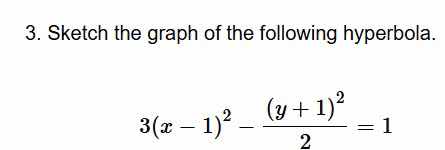
3. sketch the graph of the following hyperbola.\n\n$$3(x-1)^{2}-\\frac{(y+1)^{2}}{2}=1$$
Answer
Explanation:
Step1: Identify the standard form and center
The equation is $\frac{(x-h)^2}{a^2} - \frac{(y-k)^2}{b^2} = 1$. The center $(h, k)$ is $(1, -1)$.
Step2: Determine the semi-axes lengths
Rewrite $3(x-1)^2$ as $\frac{(x-1)^2}{1/3}$. Thus, $a^2 = \frac{1}{3} \Rightarrow a = \frac{1}{\sqrt{3}} \approx 0.58$ and $b^2 = 2 \Rightarrow b = \sqrt{2} \approx 1.41$.
Step3: Locate the vertices
The hyperbola opens horizontally. Vertices are $(h \pm a, k)$: $(1 \pm \frac{1}{\sqrt{3}}, -1)$, approximately $(0.42, -1)$ and $(1.58, -1)$.
Step4: Determine the asymptotes
The equations for the asymptotes are $y - k = \pm \frac{b}{a}(x - h)$. $$y + 1 = \pm \frac{\sqrt{2}}{1/\sqrt{3}}(x - 1) \Rightarrow y + 1 = \pm \sqrt{6}(x - 1)$$
Step5: Sketch the graph
Plot the center $(1, -1)$, the vertices, and the asymptotes. Draw two branches opening left and right from the vertices, approaching the asymptotes.
Answer:
The graph is a horizontal hyperbola centered at $(1, -1)$. Its vertices are at $(1 - \frac{\sqrt{3}}{3}, -1)$ and $(1 + \frac{\sqrt{3}}{3}, -1)$. The asymptotes are the lines $y = \sqrt{6}x - \sqrt{6} - 1$ and $y = -\sqrt{6}x + \sqrt{6} - 1$.