at the snack bar, hot dogs cost $4 each and bottled water costs $2 each. in the first business hour of the…
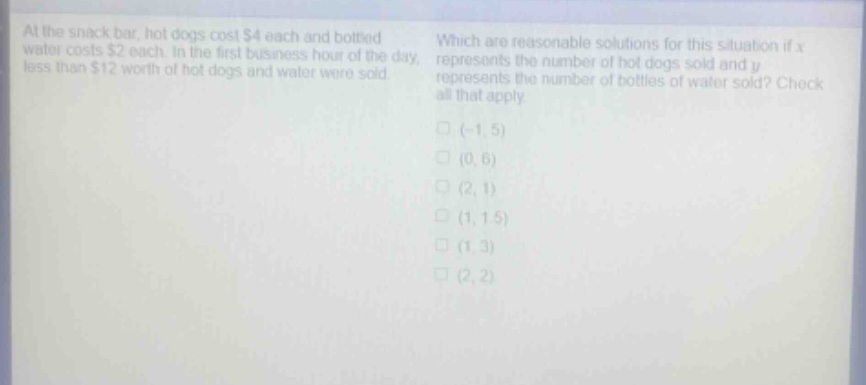
at the snack bar, hot dogs cost $4 each and bottled water costs $2 each. in the first business hour of the day, less than $12 worth of hot dogs and water were sold. which are reasonable solutions for this situation if x represents the number of hot dogs sold and y represents the number of bottles of water sold? check all that apply. (-1, 5) (0, 6) (2, 1) (1, 1.5) (1, 3) (2, 2)
Answer
Explanation:
Step1: Set up the inequality
The cost of hot - dogs is $4 per hot - dog and the cost of bottled water is $2 per bottle. The total amount sold is less than $12. So the inequality is $4x + 2y<12$, which simplifies to $2x + y<6$. Also, $x\geq0$ and $y\geq0$ since the number of items sold cannot be negative.
Step2: Check each option
Option 1: $(-1,5)$
Since $x=-1<0$, it is not a reasonable solution as the number of hot - dogs sold cannot be negative.
Option 2: $(0,6)$
Substitute $x = 0$ and $y = 6$ into $2x + y$. We get $2\times0+6=6$, but the inequality is $2x + y<6$, so $(0,6)$ is not a solution.
Option 3: $(2,1)$
Substitute $x = 2$ and $y = 1$ into $2x + y$. We have $2\times2 + 1=4 + 1=5<6$. Also, $x = 2\geq0$ and $y = 1\geq0$, so $(2,1)$ is a solution.
Option 4: $(1,1.5)$
Since the number of bottles of water $y = 1.5$ is not a whole number (we usually sell whole bottles in this context), it is not a reasonable solution.
Option 5: $(1,3)$
Substitute $x = 1$ and $y = 3$ into $2x + y$. We get $2\times1+3=2 + 3=5<6$. Also, $x = 1\geq0$ and $y = 3\geq0$, so $(1,3)$ is a solution.
Option 6: $(2,2)$
Substitute $x = 2$ and $y = 2$ into $2x + y$. We have $2\times2+2=4 + 2=6$, but the inequality is $2x + y<6$, so $(2,2)$ is not a solution.
Answer:
$(2,1),(1,3)$