the solid graph is a translation of $f(x)=sqrt3{x}$. how was the graph of $f(x)=sqrt3{x}$ shifted to form…
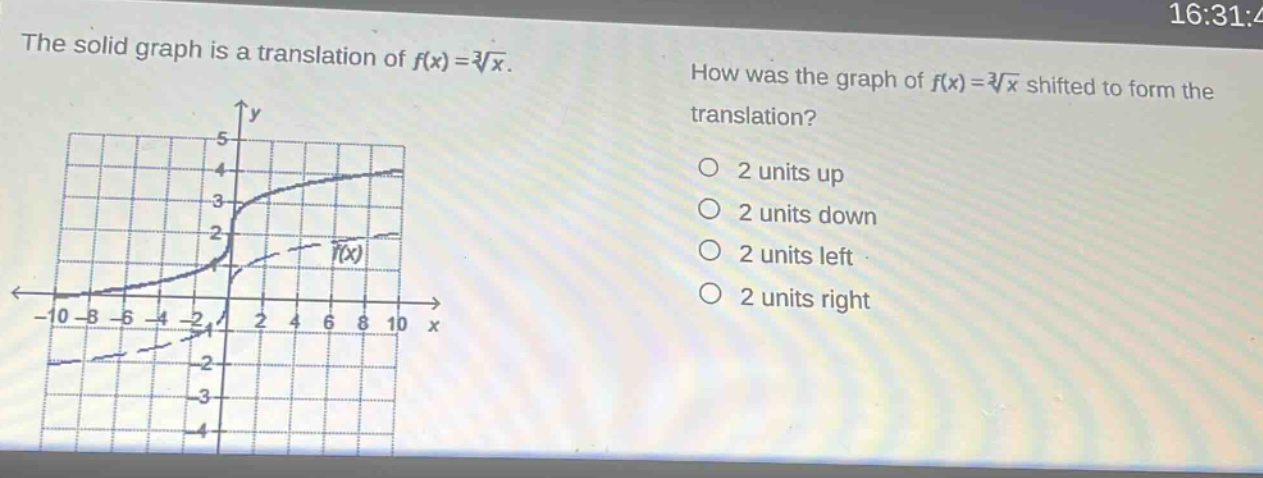
the solid graph is a translation of $f(x)=sqrt3{x}$. how was the graph of $f(x)=sqrt3{x}$ shifted to form the translation? 2 units up 2 units down 2 units left 2 units right
Answer
Explanation:
Step1: Recall graph - shifting rules
For a function (y = f(x)), a vertical shift is of the form (y=f(x)+k) (up if (k>0) and down if (k < 0)), and a horizontal shift is of the form (y = f(x - h)) (right if (h>0) and left if (h < 0)).
Step2: Identify the shift from the graph
The key - point of (y=\sqrt[3]{x}) is ((0,0)). Looking at the solid graph, the corresponding key - point has moved from ((0,0)) to ((0,2)).
Step3: Determine the type of shift
Since the (x) - coordinate of the key - point remains the same and the (y) - coordinate has increased by 2, the graph of (y = \sqrt[3]{x}) has been shifted 2 units up.
Answer:
2 units up