what is the solution to 2log₉(x)=log₉8 + log₉(x - 2)?\no x=-4\no x=-2\no x=4\no x=8
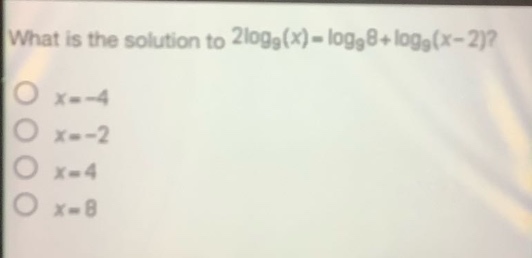
what is the solution to 2log₉(x)=log₉8 + log₉(x - 2)?\no x=-4\no x=-2\no x=4\no x=8
Answer
Explanation:
Step1: Use logarithm property
By the power - rule of logarithms (n\log_aM=\log_aM^n), (2\log_9(x)=\log_9(x^2)). By the product - rule of logarithms (\log_aM+\log_aN = \log_a(MN)), (\log_98+\log_9(x - 2)=\log_9(8(x - 2))). So the equation becomes (\log_9(x^2)=\log_9(8(x - 2))).
Step2: Remove logarithms
Since the logarithmic function (y = \log_9u) is one - to - one, if (\log_9(x^2)=\log_9(8(x - 2))), then (x^2=8(x - 2)).
Step3: Expand and rearrange
Expand the right - hand side: (x^2=8x-16). Rearrange to get a quadratic equation: (x^2 - 8x + 16 = 0).
Step4: Solve quadratic equation
The quadratic equation (x^2 - 8x + 16=(x - 4)^2 = 0). Solving ((x - 4)^2 = 0) gives (x = 4).
Step5: Check domain
For the original logarithmic equation (\log_9(x)) and (\log_9(x - 2)) to be well - defined, (x>0) and (x-2>0) (i.e., (x > 2)). When (x = 4), both (\log_9(4)) and (\log_9(4 - 2)=\log_9(2)) are well - defined.
Answer:
(x = 4)