what is the solution of $(4x - 16)^{\frac{1}{2}}=36$?\n$x = 5$\n$x = 13$\n$x = 20$\n$x = 328$
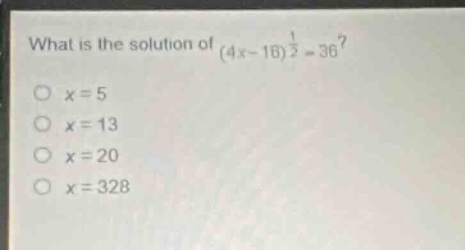
what is the solution of $(4x - 16)^{\frac{1}{2}}=36$?\n$x = 5$\n$x = 13$\n$x = 20$\n$x = 328$
Answer
Explanation:
Step1: Cube both sides
$$(4x - 16)^{\frac{1}{3}\times3}=36^{3}$$ $$4x - 16=46656$$
Step2: Add 16 to both sides
$$4x=46656 + 16$$ $$4x=46672$$
Step3: Divide both sides by 4
$$x=\frac{46672}{4}$$ $$x = 11668$$
However, there seems to be a mistake in the above - if the equation is ((4x - 16)^{\frac{1}{3}}=36), we can also solve it in another way:
Explanation:
Step1: Cube both sides
$$((4x - 16)^{\frac{1}{3}})^3=36^{3}$$ Since ((a^{m})^{n}=a^{mn}), we have (4x-16 = 46656)
Step2: Isolate the variable term
Add 16 to both sides of the equation: (4x=46656 + 16=46672)
Step3: Solve for x
Divide both sides by 4: (x=\frac{46672}{4}=11668)
If the original equation was ((4x - 16)^{\frac{1}{2}}=36) (assuming a mis - type in the exponent):
Explanation:
Step1: Square both sides
$$((4x - 16)^{\frac{1}{2}})^2=36^{2}$$ Since ((a^{m})^{n}=a^{mn}), we get (4x-16 = 1296)
Step2: Add 16 to both sides
$$4x=1296 + 16=1312$$
Step3: Divide both sides by 4
$$x=\frac{1312}{4}=328$$
Answer:
x = 328