which solution to the equation $\frac{3}{2g + 8}=\frac{g + 2}{g^{2}-16}$ is extraneous?\n$g=-4$\n$g=-4$ and…
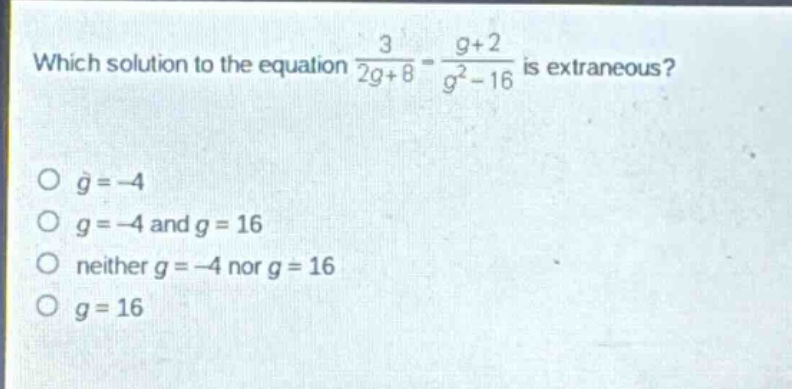
which solution to the equation $\frac{3}{2g + 8}=\frac{g + 2}{g^{2}-16}$ is extraneous?\n$g=-4$\n$g=-4$ and $g = 16$\nneither $g=-4$ nor $g = 16$\n$g = 16$
Answer
Explanation:
Step1: Factor the denominators
Factor (2g + 8=2(g + 4)) and (g^{2}-16=(g + 4)(g - 4)). The equation (\frac{3}{2g + 8}=\frac{g + 2}{g^{2}-16}) becomes (\frac{3}{2(g + 4)}=\frac{g + 2}{(g + 4)(g - 4)}).
Step2: Find the common - denominator and cross - multiply
The common denominator is (2(g + 4)(g - 4)). Cross - multiplying gives (3(g - 4)=2(g + 2)).
Step3: Expand both sides
Expand: (3g-12 = 2g+4).
Step4: Solve for (g)
Subtract (2g) from both sides: (3g-2g-12=2g-2g + 4), so (g-12 = 4). Then add 12 to both sides: (g=16).
Step5: Check for extraneous solutions
The original equation has denominators (2g + 8) and (g^{2}-16). A value of (g) is extraneous if it makes a denominator equal to 0. Set (2g + 8=0), then (2g=-8), (g=-4). Set (g^{2}-16 = 0), then ((g + 4)(g - 4)=0), (g=-4) or (g = 4). When (g=-4), the original denominators (2g + 8=2(-4)+8=0) and (g^{2}-16=(-4)^{2}-16 = 0). So (g=-4) is an extraneous solution.
Answer:
A. (g=-4)