which solution to the equation $\frac{1}{x - 1}=\frac{x - 2}{2x^{2}-2}$ is extraneous?\no $x = 1$ and…
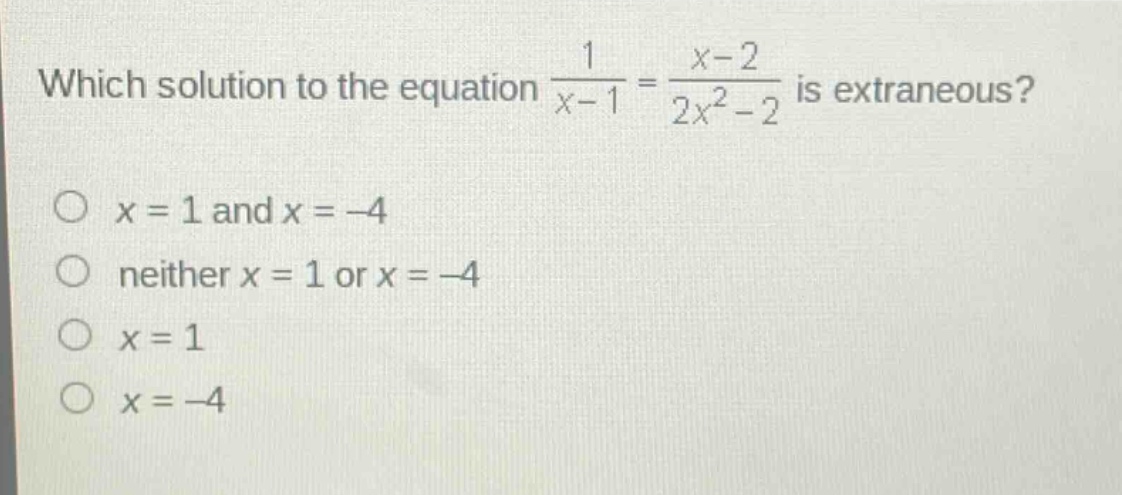
which solution to the equation $\frac{1}{x - 1}=\frac{x - 2}{2x^{2}-2}$ is extraneous?\no $x = 1$ and $x=-4$\no neither $x = 1$ or $x=-4$\no $x = 1$\no $x=-4$
Answer
Explanation:
Step1: Factor the denominator
Factor $2x^{2}-2 = 2(x^{2}-1)=2(x - 1)(x + 1)$. The original equation $\frac{1}{x - 1}=\frac{x - 2}{2x^{2}-2}$ becomes $\frac{1}{x - 1}=\frac{x - 2}{2(x - 1)(x + 1)}$.
Step2: Multiply both sides by $2(x - 1)(x + 1)$
$2(x + 1)=x - 2$.
Step3: Expand and solve for $x$
Expand the left - hand side: $2x+2=x - 2$. Subtract $x$ from both sides: $2x - x+2=x - x - 2$, which gives $x+2=-2$. Then subtract 2 from both sides: $x=-4$.
Step4: Check for extraneous solutions
The original equation has a denominator of $x - 1$ and $2x^{2}-2$. A value of $x$ that makes the denominator equal to 0 is an extraneous solution. The denominator $x - 1 = 0$ when $x = 1$ and $2x^{2}-2=2(x - 1)(x + 1)=0$ when $x = 1$ or $x=-1$. Since $x = 1$ makes the original denominators 0, it is an extraneous solution.
Answer:
C. $x = 1$