what is the solution to the equation $\frac{m}{m + 4}+\frac{4}{4 - m}=\frac{m^{2}}{m^{2}-16}$?\n$m=-4$\n$m=-2…
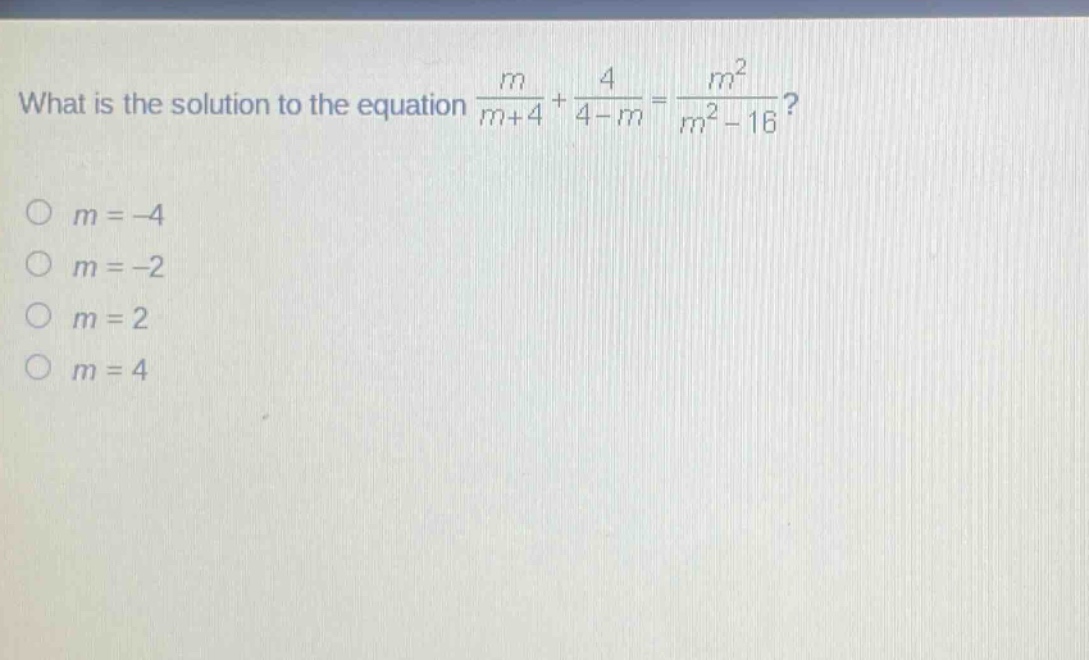
what is the solution to the equation $\frac{m}{m + 4}+\frac{4}{4 - m}=\frac{m^{2}}{m^{2}-16}$?\n$m=-4$\n$m=-2$\n$m = 2$\n$m = 4$
Answer
Explanation:
Step1: Factor the denominator
Note that $m^{2}-16=(m + 4)(m - 4)$. The given equation $\frac{m}{m + 4}+\frac{4}{4 - m}=\frac{m^{2}}{m^{2}-16}$ can be rewritten as $\frac{m}{m + 4}-\frac{4}{m - 4}=\frac{m^{2}}{(m + 4)(m - 4)}$.
Step2: Find the common - denominator and simplify
The common denominator of the left - hand side is $(m + 4)(m - 4)$. So, $\frac{m(m - 4)-4(m + 4)}{(m + 4)(m - 4)}=\frac{m^{2}}{(m + 4)(m - 4)}$. Since the denominators are the same, we can set the numerators equal: $m(m - 4)-4(m + 4)=m^{2}$.
Step3: Expand the left - hand side
Expand $m(m - 4)-4(m + 4)$: $m^{2}-4m-4m - 16=m^{2}$.
Step4: Simplify the equation
Subtract $m^{2}$ from both sides: $m^{2}-m^{2}-8m-16 = 0$, which simplifies to $-8m-16 = 0$.
Step5: Solve for m
Add 16 to both sides: $-8m=16$. Then divide both sides by $-8$, we get $m=-2$.
Step6: Check for extraneous solutions
We need to check if the solution makes the original denominators equal to 0. When $m=-2$, $m + 4=-2 + 4 = 2\neq0$, $4 - m=4-(-2)=6\neq0$, and $m^{2}-16=4 - 16=-12\neq0$.
Answer:
$m=-2$