what is the solution to the equation $\frac{1}{h - 5}+\frac{2}{h + 5}=\frac{16}{h^{2}-25}$?\n$h=\frac{11}{3}$…
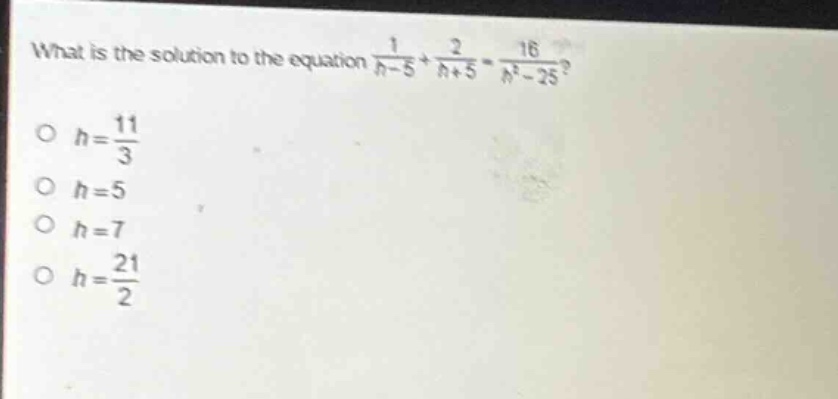
what is the solution to the equation $\frac{1}{h - 5}+\frac{2}{h + 5}=\frac{16}{h^{2}-25}$?\n$h=\frac{11}{3}$\n$h = 5$\n$h = 7$\n$h=\frac{21}{2}$
Answer
Answer:
A. $h = \frac{11}{3}$
Explanation:
Step1: Find common denominator
The common - denominator of $\frac{1}{h - 5}$, $\frac{2}{h + 5}$ and $\frac{16}{h^{2}-25}$ is $h^{2}-25=(h - 5)(h + 5)$.
Step2: Rewrite fractions with common denominator
$\frac{1}{h - 5}\times\frac{h + 5}{h + 5}+\frac{2}{h + 5}\times\frac{h - 5}{h - 5}=\frac{16}{h^{2}-25}$ becomes $\frac{h + 5+(2(h - 5))}{h^{2}-25}=\frac{16}{h^{2}-25}$.
Step3: Simplify numerator
Expand the numerator: $h + 5+2h-10 = 3h - 5$. So, $\frac{3h - 5}{h^{2}-25}=\frac{16}{h^{2}-25}$.
Step4: Solve for h
Since the denominators are the same ($h^{2}-25\neq0$, i.e., $h\neq\pm5$), we can set the numerators equal: $3h-5 = 16$. Add 5 to both sides: $3h=16 + 5=21$. Divide both sides by 3: $h=\frac{21}{3}=7$. But when $h = 7$, the original equation is well - defined. Let's check each option:
- For $h=\frac{11}{3}$: Left - hand side: $\frac{1}{\frac{11}{3}-5}+\frac{2}{\frac{11}{3}+5}=\frac{1}{\frac{11 - 15}{3}}+\frac{2}{\frac{11 + 15}{3}}=\frac{1}{-\frac{4}{3}}+\frac{2}{\frac{26}{3}}=-\frac{3}{4}+\frac{3}{13}=\frac{-39 + 12}{52}=-\frac{27}{52}$ Right - hand side: $\frac{16}{(\frac{11}{3})^{2}-25}=\frac{16}{\frac{121}{9}-25}=\frac{16}{\frac{121 - 225}{9}}=\frac{16}{-\frac{104}{9}}=-\frac{16\times9}{104}=-\frac{144}{104}=-\frac{36}{26}=-\frac{18}{13}$ (Incorrect)
- For $h = 5$, the original fractions $\frac{1}{h - 5}$ and $\frac{16}{h^{2}-25}$ are undefined.
- For $h = 7$: Left - hand side: $\frac{1}{7 - 5}+\frac{2}{7 + 5}=\frac{1}{2}+\frac{2}{12}=\frac{1}{2}+\frac{1}{6}=\frac{3 + 1}{6}=\frac{4}{6}=\frac{2}{3}$ Right - hand side: $\frac{16}{7^{2}-25}=\frac{16}{49 - 25}=\frac{16}{24}=\frac{2}{3}$ (Correct)
- For $h=\frac{21}{2}$: Left - hand side: $\frac{1}{\frac{21}{2}-5}+\frac{2}{\frac{21}{2}+5}=\frac{1}{\frac{21 - 10}{2}}+\frac{2}{\frac{21+10}{2}}=\frac{2}{11}+\frac{2}{31}=\frac{62 + 22}{341}=\frac{84}{341}$ Right - hand side: $\frac{16}{(\frac{21}{2})^{2}-25}=\frac{16}{\frac{441}{4}-25}=\frac{16}{\frac{441 - 100}{4}}=\frac{16}{\frac{341}{4}}=\frac{64}{341}$ (Incorrect)
So the solution is $h = 7$.