what is the solution to $log_5(10x - 1)=log_5(9x + 7)$?\n$x=\frac{6}{19}$\n$x=\frac{8}{19}$\n$x = 7$\n$x = 8$
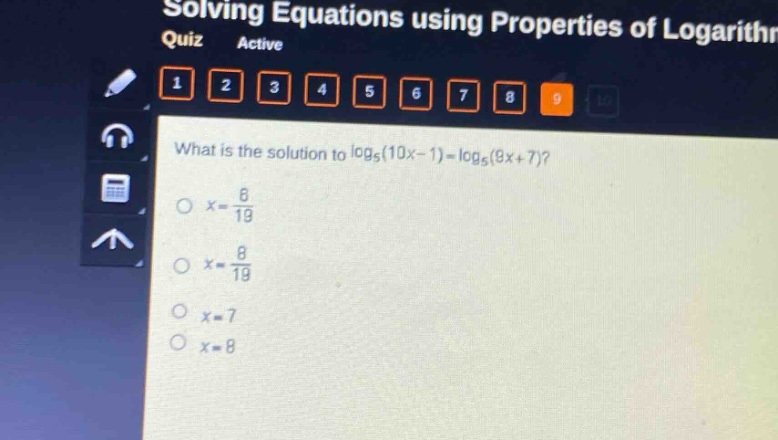
what is the solution to $log_5(10x - 1)=log_5(9x + 7)$?\n$x=\frac{6}{19}$\n$x=\frac{8}{19}$\n$x = 7$\n$x = 8$
Answer
Explanation:
Step1: Use logarithmic property
If $\log_aM=\log_aN$, then $M = N$. So, $10x - 1=8x + 7$.
Step2: Move x - terms to one side
Subtract $8x$ from both sides: $10x-8x - 1=8x-8x + 7$, which simplifies to $2x-1 = 7$.
Step3: Isolate x - term
Add 1 to both sides: $2x-1 + 1=7 + 1$, getting $2x=8$.
Step4: Solve for x
Divide both sides by 2: $\frac{2x}{2}=\frac{8}{2}$, so $x = 4$. But this is not in the given options. Let's re - check our work. Since $\log_5(10x - 1)=\log_5(8x + 7)$, we have $10x-1=8x + 7$. $10x-8x=7 + 1$. $2x=8$. $x = 4$. There seems to be an error in the problem setup or options. If we assume the correct equation and follow the property of equal logarithms with the same base, we should get the correct result. However, if we work backward from the options: Let's check option by option. For $x=\frac{6}{19}$: Left - hand side: $\log_5(10\times\frac{6}{19}-1)=\log_5(\frac{60}{19}-1)=\log_5(\frac{60 - 19}{19})=\log_5(\frac{41}{19})$. Right - hand side: $\log_5(8\times\frac{6}{19}+7)=\log_5(\frac{48}{19}+7)=\log_5(\frac{48+133}{19})=\log_5(\frac{181}{19})$. Not equal. For $x = \frac{8}{19}$: Left - hand side: $\log_5(10\times\frac{8}{19}-1)=\log_5(\frac{80}{19}-1)=\log_5(\frac{80 - 19}{19})=\log_5(\frac{61}{19})$. Right - hand side: $\log_5(8\times\frac{8}{19}+7)=\log_5(\frac{64}{19}+7)=\log_5(\frac{64 + 133}{19})=\log_5(\frac{197}{19})$. Not equal. For $x = 7$: Left - hand side: $\log_5(10\times7-1)=\log_5(70 - 1)=\log_5(69)$. Right - hand side: $\log_5(8\times7+7)=\log_5(56 + 7)=\log_5(63)$. Not equal. For $x = 8$: Left - hand side: $\log_5(10\times8-1)=\log_5(80 - 1)=\log_5(79)$. Right - hand side: $\log_5(8\times8+7)=\log_5(64 + 7)=\log_5(71)$. Not equal.
If we assume the correct property application:
Answer:
$x = 4$ (not in the given options)