the solution to the system of equations shown is (2, 0). 3x - 2y = 6 x + 4y = 2 when the first equation is…
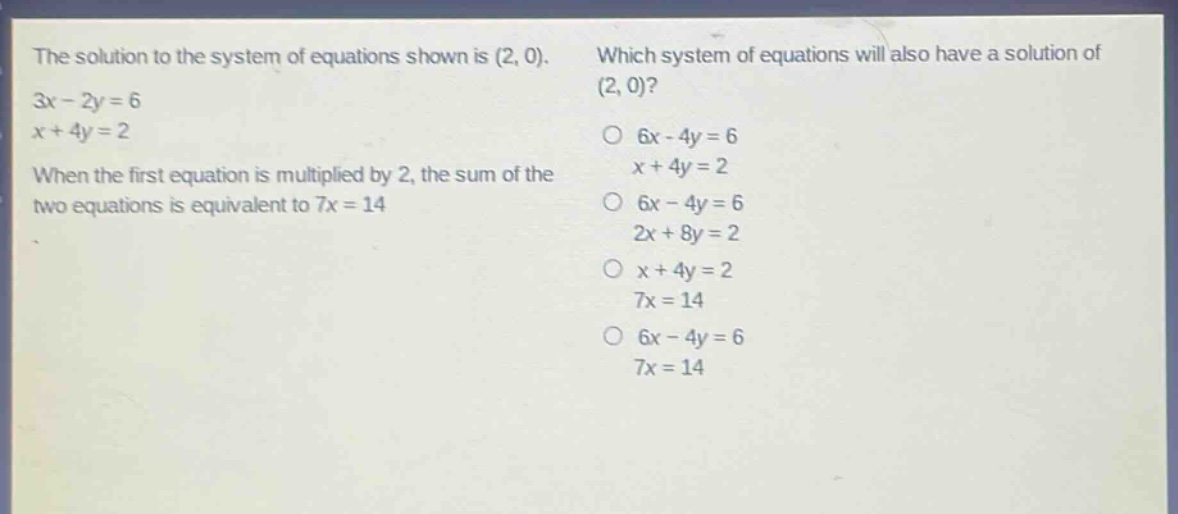
the solution to the system of equations shown is (2, 0). 3x - 2y = 6 x + 4y = 2 when the first equation is multiplied by 2, the sum of the two equations is equivalent to 7x = 14 which system of equations will also have a solution of (2, 0)? o 6x - 4y = 6 x + 4y = 2 o 6x - 4y = 6 2x + 8y = 2 o x + 4y = 2 7x = 14 o 6x - 4y = 6 7x = 14
Answer
Explanation:
Step1: Check option A
Substitute (x = 2) and (y=0) into (6x - 4y=6). Left - hand side is (6\times2-4\times0 = 12\neq6). So option A is incorrect.
Step2: Check option B
Substitute (x = 2) and (y = 0) into (6x-4y = 6), left - hand side is (6\times2-4\times0=12\neq6). So option B is incorrect.
Step3: Check option C
Substitute (x = 2) and (y = 0) into (x + 4y=2), left - hand side is (2+4\times0=2). Substitute into (7x = 14), left - hand side is (7\times2=14). So option C is correct.
Step4: Check option D
The system only has two equations but the second equation (7x = 14) alone does not form a proper system with (6x - 4y=6) in the context of checking the solution ((2,0)) as we need two non - equivalent equations in two variables. Also, we already know from option C that the combination with (x + 4y=2) and (7x = 14) works, and this option is not in the correct form.
Answer:
C. (x + 4y=2), (7x = 14)