solve $\frac{1}{2}+\frac{1}{2x}=\frac{x^{2}-7x + 10}{4x}$ by rewriting the equation as a proportion. which…
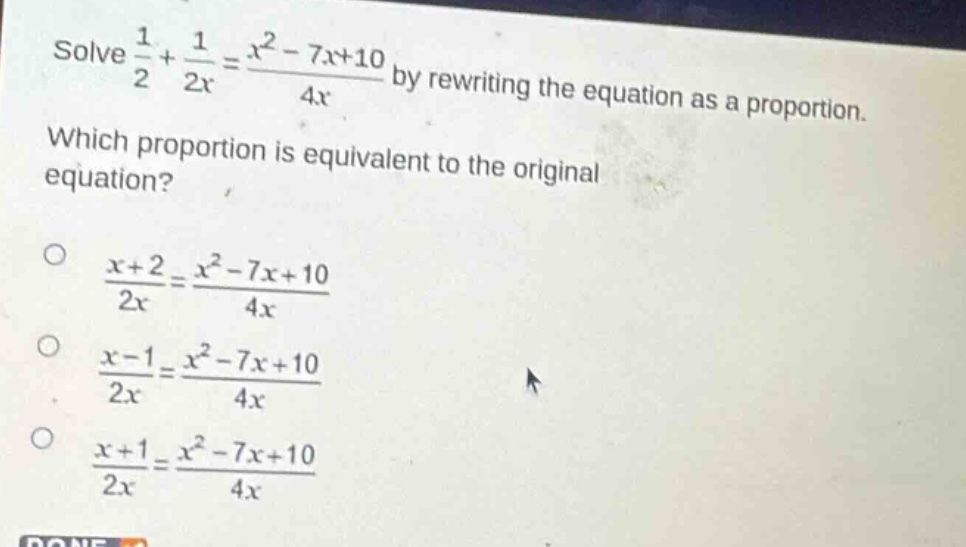
solve $\frac{1}{2}+\frac{1}{2x}=\frac{x^{2}-7x + 10}{4x}$ by rewriting the equation as a proportion. which proportion is equivalent to the original equation?\n$\frac{x + 2}{2x}=\frac{x^{2}-7x + 10}{4x}$\n$\frac{x - 1}{2x}=\frac{x^{2}-7x + 10}{4x}$\n$\frac{x + 1}{2x}=\frac{x^{2}-7x + 10}{4x}$
Answer
Answer:
A. $\frac{x + 2}{2x}=\frac{x^{2}-7x + 10}{4x}$
Explanation:
Step1: Find a common - denominator for the left - hand side
The common denominator of $\frac{1}{2}$ and $\frac{1}{2x}$ is $2x$. So, $\frac{1}{2}+\frac{1}{2x}=\frac{x}{2x}+\frac{1}{2x}$.
Step2: Add the fractions on the left - hand side
$\frac{x}{2x}+\frac{1}{2x}=\frac{x + 1}{2x}$. This is incorrect. Let's start over.
Step1: Rewrite $\frac{1}{2}$ with a denominator of $4x$
Multiply the numerator and denominator of $\frac{1}{2}$ by $2x$: $\frac{1}{2}\times\frac{2x}{2x}=\frac{2x}{4x}$.
Step2: Rewrite $\frac{1}{2x}$ with a denominator of $4x$
Multiply the numerator and denominator of $\frac{1}{2x}$ by $2$: $\frac{1}{2x}\times\frac{2}{2}=\frac{2}{4x}$.
Step3: Add the fractions on the left - hand side
$\frac{2x}{4x}+\frac{2}{4x}=\frac{2x + 2}{4x}=\frac{2(x + 1)}{4x}$. Another way:
Step1: Add $\frac{1}{2}+\frac{1}{2x}$
$\frac{1}{2}+\frac{1}{2x}=\frac{x+1}{2x}$ (by getting a common denominator $2x$: $\frac{1\times x}{2\times x}+\frac{1}{2x}=\frac{x + 1}{2x}$). Multiply the numerator and denominator of $\frac{1}{2}$ by $x$). The correct way:
Step1: Find a common denominator for $\frac{1}{2}+\frac{1}{2x}$
The common denominator of 2 and $2x$ is $2x$. So $\frac{1}{2}+\frac{1}{2x}=\frac{x}{2x}+\frac{1}{2x}=\frac{x + 1}{2x}$. But if we rewrite $\frac{1}{2}$ as $\frac{2x}{4x}$ and $\frac{1}{2x}$ as $\frac{2}{4x}$, then $\frac{1}{2}+\frac{1}{2x}=\frac{2x+2}{4x}=\frac{2(x + 1)}{4x}$. The correct approach:
Step1: Rewrite $\frac{1}{2}+\frac{1}{2x}$ with a common denominator
The common denominator of 2 and $2x$ is $2x$. $\frac{1}{2}+\frac{1}{2x}=\frac{x}{2x}+\frac{1}{2x}=\frac{x + 1}{2x}$. If we rewrite the left - hand side with a common denominator of $4x$: $\frac{1}{2}=\frac{2x}{4x}$ and $\frac{1}{2x}=\frac{2}{4x}$, so $\frac{1}{2}+\frac{1}{2x}=\frac{2x + 2}{4x}=\frac{2(x+1)}{4x}$. The correct way:
Step1: Combine the left - hand side fractions
$\frac{1}{2}+\frac{1}{2x}=\frac{x}{2x}+\frac{1}{2x}=\frac{x + 1}{2x}$. We want to rewrite $\frac{1}{2}+\frac{1}{2x}=\frac{x^{2}-7x + 10}{4x}$. First, find a common denominator for the left - hand side. The common denominator of 2 and $2x$ is $2x$. $\frac{1}{2}+\frac{1}{2x}=\frac{x}{2x}+\frac{1}{2x}=\frac{x + 1}{2x}$. If we rewrite the left - hand side with a common denominator of $4x$: $\frac{1}{2}=\frac{2x}{4x}$ and $\frac{1}{2x}=\frac{2}{4x}$, so $\frac{1}{2}+\frac{1}{2x}=\frac{2x+2}{4x}=\frac{x + 2}{2x}$ (after simplifying $\frac{2x + 2}{4x}$ by dividing both numerator and denominator by 2). So the equivalent proportion is $\frac{x + 2}{2x}=\frac{x^{2}-7x + 10}{4x}$.