solve: $left(\frac{1}{4}\right)^{3z - 1}=16^{z + 2}cdot64^{z - 2}$\nz = \ndone
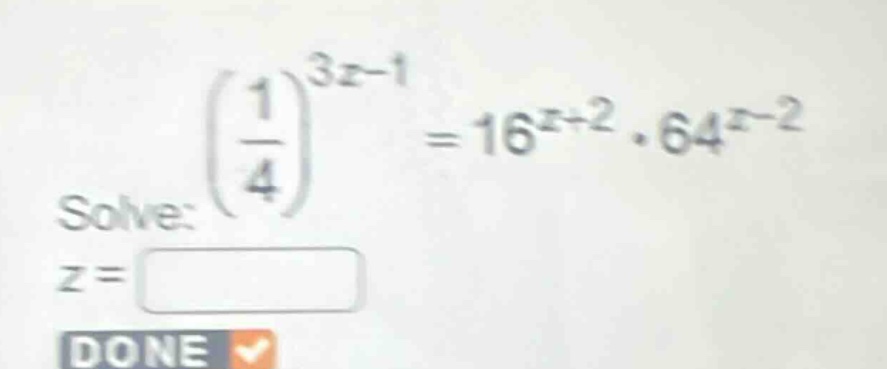
solve: $left(\frac{1}{4}\right)^{3z - 1}=16^{z + 2}cdot64^{z - 2}$\nz = \ndone
Answer
Explanation:
Step1: Rewrite bases as powers of 2
$(\frac{1}{4})^{3z - 1}=(2^{-2})^{3z - 1}=2^{-6z + 2}$, $16^{z+2}=(2^{4})^{z + 2}=2^{4z+8}$, $64^{z - 2}=(2^{6})^{z - 2}=2^{6z-12}$. So the equation becomes $2^{-6z + 2}=2^{4z + 8}\cdot2^{6z-12}$.
Step2: Use exponent - product rule
According to the rule $a^{m}\cdot a^{n}=a^{m + n}$, $2^{4z + 8}\cdot2^{6z-12}=2^{(4z + 8)+(6z-12)}=2^{10z-4}$. So we have $2^{-6z + 2}=2^{10z-4}$.
Step3: Set exponents equal
Since the bases are the same, we can set the exponents equal: $-6z + 2=10z-4$.
Step4: Solve for z
Add $6z$ to both sides: $2 = 10z-4+6z$, which simplifies to $2=16z - 4$. Add 4 to both sides: $2 + 4=16z$, so $6 = 16z$. Divide both sides by 16: $z=\frac{6}{16}=\frac{3}{8}$.
Answer:
$\frac{3}{8}$