solve the radical equation $x - 7=sqrt{-4x + 28}$. which statement is true about the solutions to the…
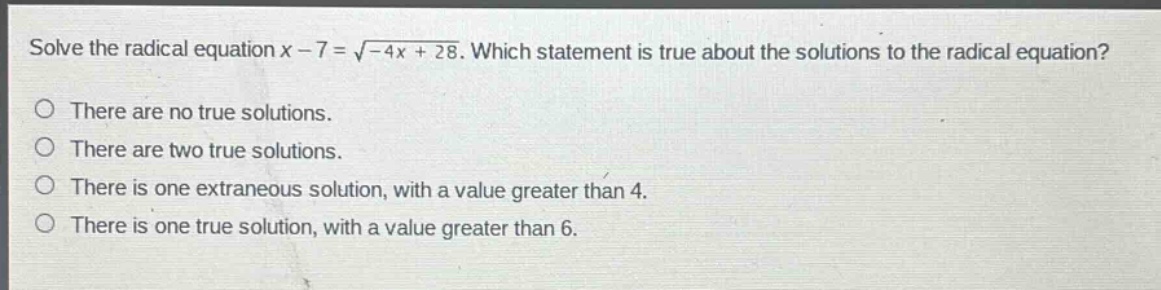
solve the radical equation $x - 7=sqrt{-4x + 28}$. which statement is true about the solutions to the radical equation?\nthere are no true solutions.\nthere are two true solutions.\nthere is one extraneous solution, with a value greater than 4.\nthere is one true solution, with a value greater than 6.
Answer
Explanation:
Step1: Square both sides
Square both sides of the equation (x - 7=\sqrt{-4x + 28}) to get ((x - 7)^2=-4x + 28). Expanding the left - hand side using the formula ((a - b)^2=a^{2}-2ab + b^{2}), we have (x^{2}-14x + 49=-4x + 28).
Step2: Rearrange to quadratic form
Move all terms to one side to form a quadratic equation: (x^{2}-14x+4x + 49 - 28 = 0), which simplifies to (x^{2}-10x + 21 = 0).
Step3: Factor the quadratic equation
Factor the quadratic equation (x^{2}-10x + 21 = 0) as ((x - 3)(x - 7)=0). Setting each factor equal to zero gives (x-3 = 0) or (x - 7=0), so (x = 3) or (x = 7).
Step4: Check for extraneous solutions
For (x = 3), the left - hand side of the original equation is (3-7=-4), and the right - hand side is (\sqrt{-4\times3 + 28}=\sqrt{-12 + 28}=\sqrt{16}=4). Since (-4\neq4), (x = 3) is an extraneous solution. For (x = 7), the left - hand side is (7-7 = 0), and the right - hand side is (\sqrt{-4\times7+28}=\sqrt{-28 + 28}=0). So (x = 7) is a valid solution.
Answer:
There is one true solution, with a value greater than 6.