solve for x. round to the nearest tenth.
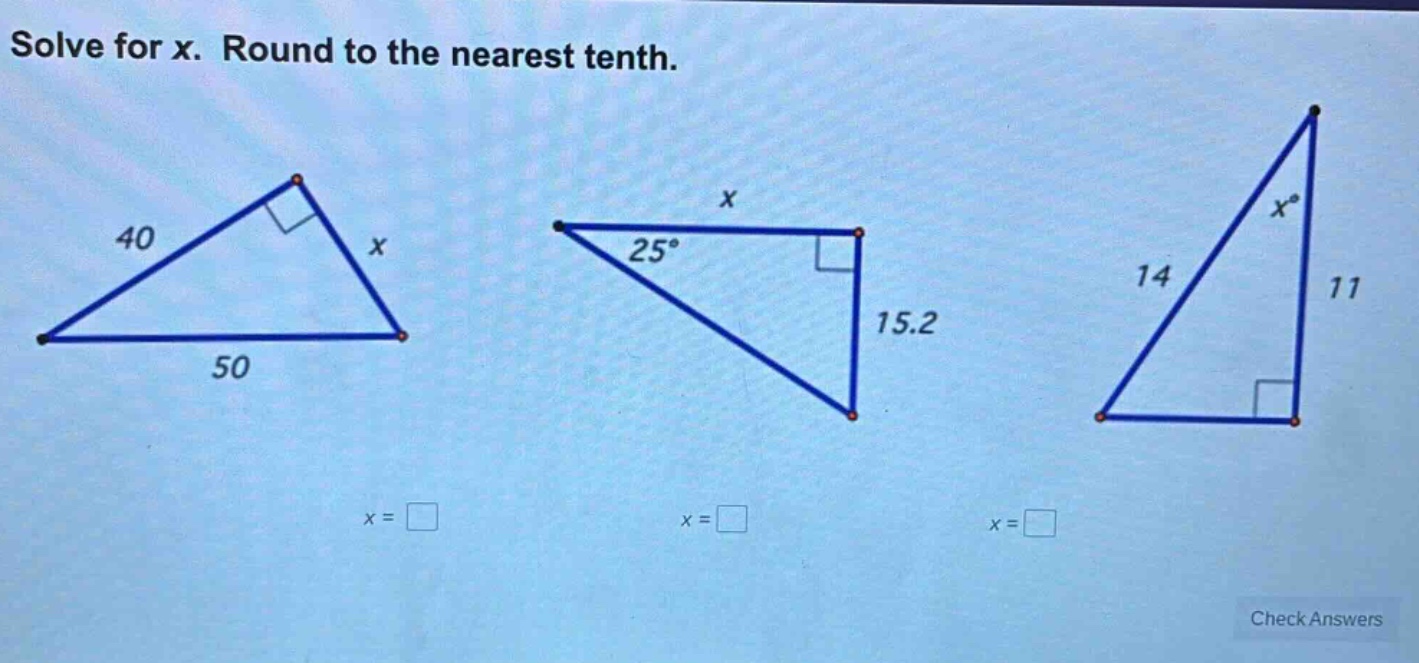
solve for x. round to the nearest tenth.
Answer
Answer:
- For the first triangle:
- Using the Pythagorean theorem (a^{2}+b^{2}=c^{2}), where (c = 50), (a = 40), and (b=x).
- (x=\sqrt{50^{2}-40^{2}}=\sqrt{(50 + 40)(50 - 40)}=\sqrt{90\times10}=\sqrt{900}=30.0)
- For the second triangle:
- We know that (\tan\theta=\frac{\text{opposite}}{\text{adjacent}}). Here (\theta = 25^{\circ}) and the opposite - side is (15.2), and the adjacent - side is (x).
- (\tan25^{\circ}=\frac{15.2}{x}), so (x=\frac{15.2}{\tan25^{\circ}}\approx\frac{15.2}{0.4663}\approx32.6)
- For the third triangle:
- Using the cosine function (\cos x=\frac{\text{adjacent}}{\text{hypotenuse}}). Here the adjacent - side is (11) and the hypotenuse is (14).
- (x=\cos^{-1}(\frac{11}{14})\approx38.2^{\circ})
So the answers are (x = 30.0), (x\approx32.6), (x\approx38.2)
Explanation:
Step1: First triangle - Pythagorean theorem
Use (x=\sqrt{c^{2}-a^{2}}), (c = 50), (a = 40)
Step2: Second triangle - Tangent function
Use (x=\frac{\text{opposite}}{\tan\theta}), (\theta = 25^{\circ}), opposite ( = 15.2)
Step3: Third triangle - Cosine function
Use (x=\cos^{-1}(\frac{\text{adjacent}}{\text{hypotenuse}})), adjacent ( = 11), hypotenuse ( = 14)