solve: $s = 4+sqrt{s + 2}$\n$s = 2$\n$s = 7$\n$s = 2$ or $s = 7$\nno real solution
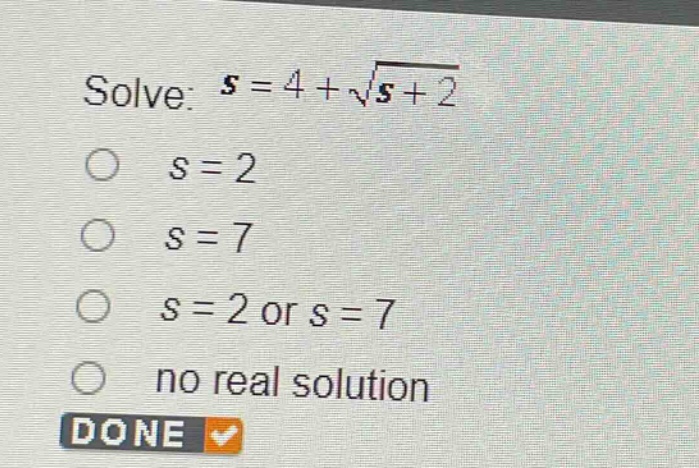
solve: $s = 4+sqrt{s + 2}$\n$s = 2$\n$s = 7$\n$s = 2$ or $s = 7$\nno real solution
Answer
Explanation:
Step1: Isolate the square - root term
Subtract 4 from both sides of the equation $s = 4+\sqrt{s + 2}$ to get $\sqrt{s + 2}=s - 4$.
Step2: Square both sides
$(\sqrt{s + 2})^2=(s - 4)^2$. Using the formula $(a - b)^2=a^{2}-2ab + b^{2}$, we have $s + 2=s^{2}-8s + 16$.
Step3: Rearrange to form a quadratic equation
Move all terms to one side: $s^{2}-8s - s+16 - 2 = 0$, which simplifies to $s^{2}-9s + 14 = 0$.
Step4: Factor the quadratic equation
Factor $s^{2}-9s + 14$ as $(s - 2)(s - 7)=0$.
Step5: Solve for s
Set each factor equal to zero: $s-2 = 0$ gives $s = 2$; $s - 7=0$ gives $s = 7$.
Step6: Check for extraneous solutions
For $s = 2$: $\sqrt{2+2}=2$, and $4+\sqrt{2 + 2}=4 + 2=6\neq2$, so $s = 2$ is an extraneous solution. For $s = 7$: $\sqrt{7+2}=3$, and $4+\sqrt{7 + 2}=4 + 3=7$, so $s = 7$ is a valid solution.
Answer:
$s = 7$