solve the system of inequalities: $y + 2x>3$ and $ygeq3.5x - 5$. the first inequality, $y + 2x>3$, is in…
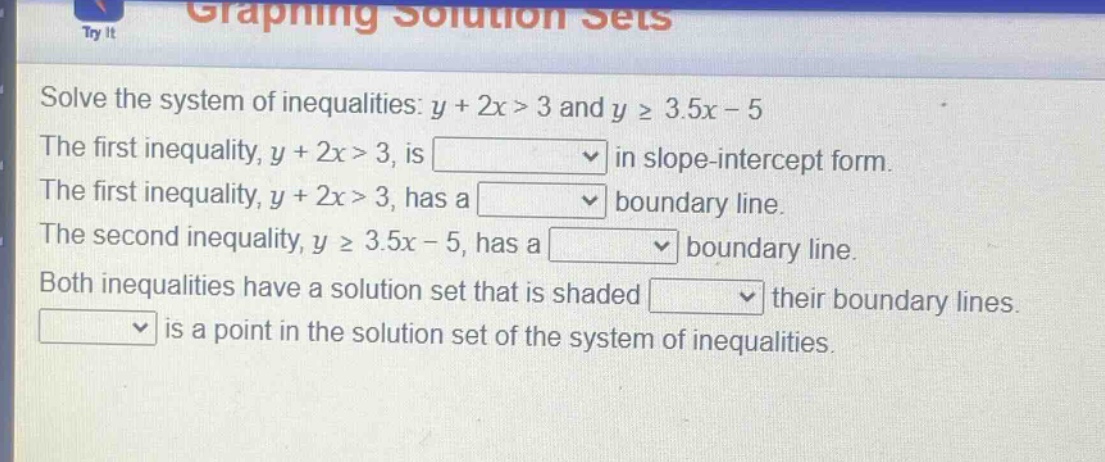
solve the system of inequalities: $y + 2x>3$ and $ygeq3.5x - 5$. the first inequality, $y + 2x>3$, is in slope - intercept form. the first inequality, $y + 2x>3$, has a boundary line. the second inequality, $ygeq3.5x - 5$, has a boundary line. both inequalities have a solution set that is shaded their boundary lines. is a point in the solution set of the system of inequalities.
Answer
Explanation:
Step1: Rewrite first - inequality to slope - intercept form
Subtract (2x) from both sides of (y + 2x>3) to get (y>-2x + 3). The original (y + 2x>3) is not in slope - intercept form ((y=mx + b)).
Step2: Determine boundary line type for first inequality
The inequality (y>-2x + 3) has a dashed boundary line because the inequality is strict ((>)).
Step3: Determine boundary line type for second inequality
The inequality (y\geq3.5x - 5) has a solid boundary line because the inequality is non - strict ((\geq)).
Step4: Determine shading direction
For (y>-2x + 3), the solution set is shaded above the boundary line. For (y\geq3.5x - 5), the solution set is shaded above the boundary line. So both inequalities have a solution set that is shaded above their boundary lines.
Step5: Find a point in the solution set
Let's test the point ((2,2)) for the first inequality: (y+2x=2 + 2\times2=6>3). For the second inequality: (y-3.5x=2-3.5\times2=2 - 7=-5\geq - 5). So ((2,2)) is a point in the solution set.
Answer:
The first inequality, (y + 2x>3), is not in slope - intercept form. The first inequality, (y + 2x>3), has a dashed boundary line. The second inequality, (y\geq3.5x - 5), has a solid boundary line. Both inequalities have a solution set that is shaded above their boundary lines. ((2,2)) is a point in the solution set of the system of inequalities.