a spinner is divided into eight equal - sized sections, numbered from 1 to 8, inclusive. what is true about…
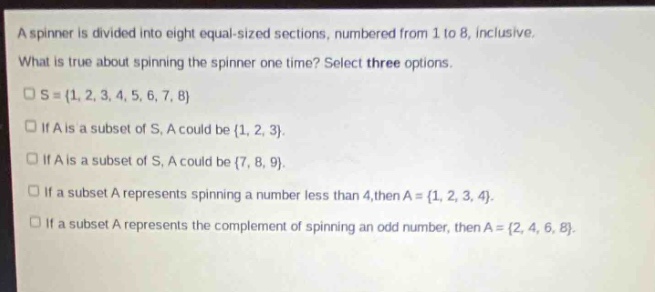
a spinner is divided into eight equal - sized sections, numbered from 1 to 8, inclusive. what is true about spinning the spinner one time? select three options. s = {1, 2, 3, 4, 5, 6, 7, 8} if a is a subset of s, a could be {1, 2, 3}. if a is a subset of s, a could be {7, 8, 9}. if a subset a represents spinning a number less than 4, then a = {1, 2, 3, 4}. if a subset a represents the complement of spinning an odd number, then a = {2, 4, 6, 8}.
Answer
Answer:
- S = {1, 2, 3, 4, 5, 6, 7, 8}
- If A is a subset of S, A could be {1, 2, 3}.
- If a subset A represents the complement of spinning an odd number, then A = {2, 4, 6, 8}.
Explanation:
Step1: Define the sample - space
The spinner has 8 equal - sized sections numbered 1 to 8. So the sample - space S is the set of all possible outcomes, S = {1, 2, 3, 4, 5, 6, 7, 8}.
Step2: Check subset possibilities
A subset of S is a set whose elements are all in S. The set {1, 2, 3} has elements that are all in S, so it can be a subset of S.
Step3: Analyze incorrect subset
The set {7, 8, 9} has an element 9 which is not in S, so it cannot be a subset of S.
Step4: Analyze number - less - than subset
If A represents spinning a number less than 4, then A = {1, 2, 3} (not {1, 2, 3, 4} as 4 is not less than 4).
Step5: Analyze complement of odd numbers
The odd numbers in S are {1, 3, 5, 7}. The complement of the set of odd numbers in S is the set of all elements in S that are not odd, which is {2, 4, 6, 8}.