f(x)=-2\\sqrt{x + 5}+4\nwhat is the effect of replacing f(x) with f(x - 3)?\na. the range of f(x - 3) is the…
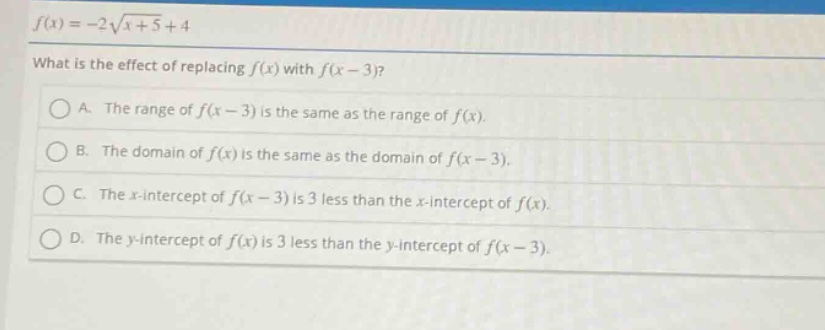
f(x)=-2\\sqrt{x + 5}+4\nwhat is the effect of replacing f(x) with f(x - 3)?\na. the range of f(x - 3) is the same as the range of f(x).\nb. the domain of f(x) is the same as the domain of f(x - 3).\nc. the x - intercept of f(x - 3) is 3 less than the x - intercept of f(x).\nd. the y - intercept of f(x) is 3 less than the y - intercept of f(x - 3).
Answer
Explanation:
Step1: Recall function - transformation rules
When we replace (f(x)) with (f(x - h)) (in this case (h = 3)), the graph of the function (y = f(x)) is shifted to the right by (h) units.
Step2: Analyze the range
The range of a function (y=-2\sqrt{x + 5}+4) is determined by the vertical - behavior of the function. Since a horizontal shift (from (f(x)) to (f(x - 3))) does not affect the vertical values that the function can take, the range of (f(x-3)) is the same as the range of (f(x)). The range of (y=-2\sqrt{x + 5}+4) is (y\leqslant4) because (\sqrt{x + 5}\geqslant0), so (-2\sqrt{x + 5}\leqslant0) and (y=-2\sqrt{x + 5}+4\leqslant4). A horizontal shift does not change this inequality.
Step3: Analyze the domain
The domain of (f(x)=-2\sqrt{x + 5}+4) is found by setting (x+5\geqslant0), so (x\geqslant - 5). The domain of (f(x - 3)=-2\sqrt{(x - 3)+5}+4=-2\sqrt{x+2}+4) is found by setting (x + 2\geqslant0), so (x\geqslant - 2). The domains are different.
Step4: Analyze the x - intercept
For (f(x)=-2\sqrt{x + 5}+4), set (y = 0): [ \begin{align*} 0&=-2\sqrt{x + 5}+4\ 2\sqrt{x + 5}&=4\ \sqrt{x + 5}&=2\ x+5&=4\ x&=-1 \end{align*} ] For (f(x - 3)=-2\sqrt{(x - 3)+5}+4=-2\sqrt{x + 2}+4), set (y = 0): [ \begin{align*} 0&=-2\sqrt{x + 2}+4\ 2\sqrt{x + 2}&=4\ \sqrt{x + 2}&=2\ x+2&=4\ x&=2 \end{align*} ] The (x) - intercept of (f(x - 3)) is (3) more than the (x) - intercept of (f(x)).
Step5: Analyze the y - intercept
For (f(x)=-2\sqrt{x + 5}+4), set (x = 0): (y=-2\sqrt{0 + 5}+4=4-2\sqrt{5}). For (f(x - 3)=-2\sqrt{(x - 3)+5}+4=-2\sqrt{x + 2}+4), set (x = 0): (y=-2\sqrt{0+2}+4=4 - 2\sqrt{2}). The (y) - intercept of (f(x)) is not (3) less than the (y) - intercept of (f(x - 3)).
Answer:
A. The range of (f(x - 3)) is the same as the range of (f(x))