if (f(x)=sqrt{\frac{1}{2}x - 10}+3), which inequality can be used to find the domain of (f(x))?\n(sqrt{\frac{…
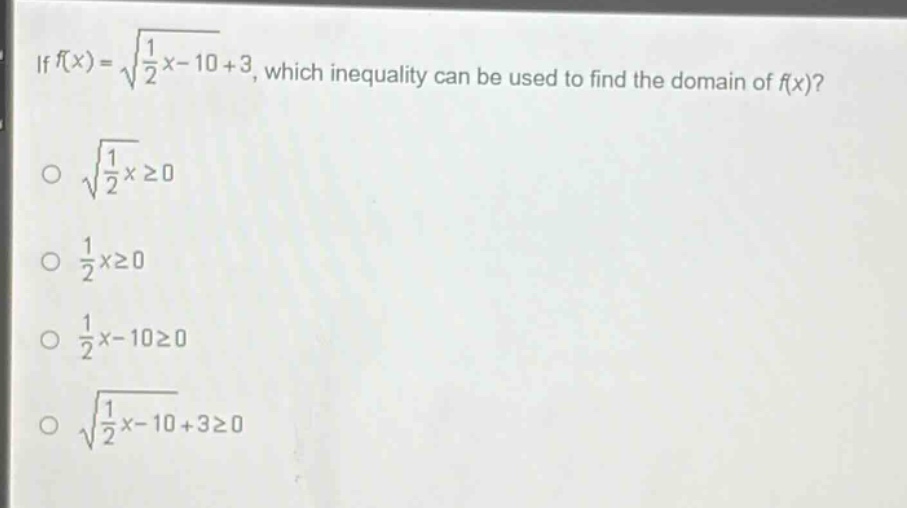
if (f(x)=sqrt{\frac{1}{2}x - 10}+3), which inequality can be used to find the domain of (f(x))?\n(sqrt{\frac{1}{2}x}geq0)\n(\frac{1}{2}xgeq0)\n(\frac{1}{2}x - 10geq0)\n(sqrt{\frac{1}{2}x - 10}+3geq0)
Answer
Explanation:
Step1: Recall domain - rule for square - root
The expression inside a square - root $\sqrt{u}$ must satisfy $u\geq0$.
Step2: Identify the expression inside the square - root
In the function $f(x)=\sqrt{\frac{1}{2}x - 10}+3$, the expression inside the square - root is $\frac{1}{2}x - 10$.
Step3: Set up the inequality
To find the domain, we set $\frac{1}{2}x - 10\geq0$.
Answer:
$\frac{1}{2}x - 10\geq0$