a square with an area of $a^{2}$ is enlarged to a square with an area of $25a^{2}$. how was the side of the…
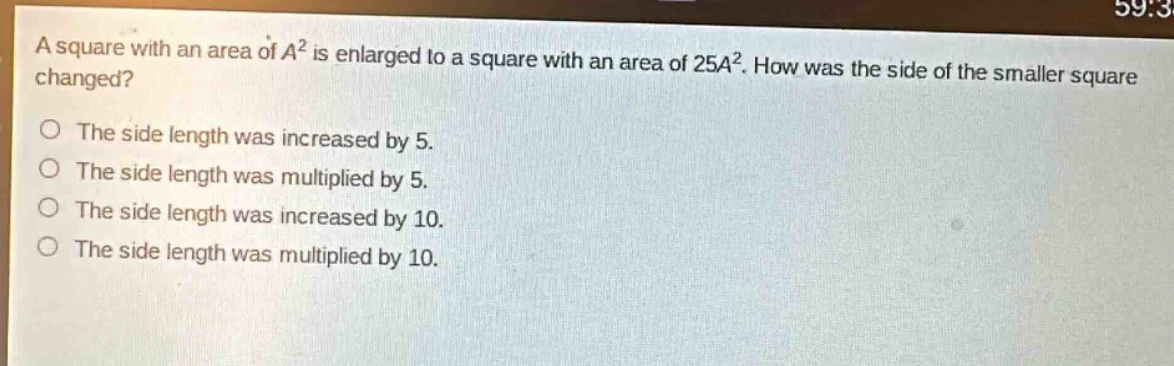
a square with an area of $a^{2}$ is enlarged to a square with an area of $25a^{2}$. how was the side of the smaller square changed?\nthe side length was increased by 5.\nthe side length was multiplied by 5.\nthe side length was increased by 10.\nthe side length was multiplied by 10.
Answer
Explanation:
Step1: Find side - length of smaller square
Let the side - length of the smaller square be $s_1$. Since the area of a square is $A = s^2$, and the area of the smaller square is $A^2$, then $s_1^2=A^2$, so $s_1 = A$.
Step2: Find side - length of larger square
Let the side - length of the larger square be $s_2$. Since the area of the larger square is $25A^2$, and $A = s^2$, then $s_2^2=25A^2$, so $s_2 = 5A$.
Step3: Determine the change in side - length
To find how the side - length has changed, we divide $s_2$ by $s_1$: $\frac{s_2}{s_1}=\frac{5A}{A}=5$. This means the side - length of the smaller square was multiplied by 5.
Answer:
The side length was multiplied by 5.