a square on a coordinate plane is translated 9 units down and 1 unit to the right. which function rule…
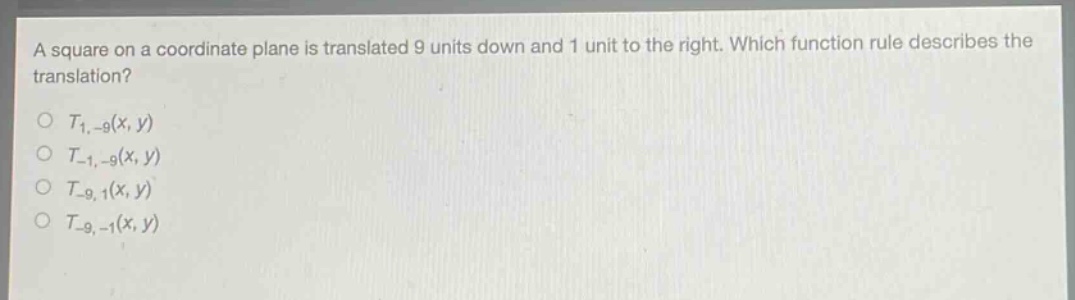
a square on a coordinate plane is translated 9 units down and 1 unit to the right. which function rule describes the translation?\n$t_{1, - 9}(x,y)$\n$t_{-1, - 9}(x,y)$\n$t_{-9,1}(x,y)$\n$t_{-9, - 1}(x,y)$
Answer
Explanation:
Step1: Recall translation rules
In a coordinate - plane, a translation of $a$ units to the right and $b$ units down for a point $(x,y)$ is given by the rule $(x,y)\to(x + a,y - b)$. Here, $a = 1$ (1 unit to the right) and $b=9$ (9 units down). The general form of a translation function is $T_{a,b}(x,y)=(x + a,y + b)$.
Step2: Determine the translation function
Substituting $a = 1$ and $b=-9$ into the translation function $T_{a,b}(x,y)$, we get $T_{1,-9}(x,y)$ since moving down means a negative change in the $y$ - coordinate and moving right means a positive change in the $x$ - coordinate.
Answer:
$T_{1,-9}(x,y)$