square rstu is translated to form rstu, which has vertices r(-8, 1), s(-4, 1), t(-4, -3), and u(-8, -3). if…
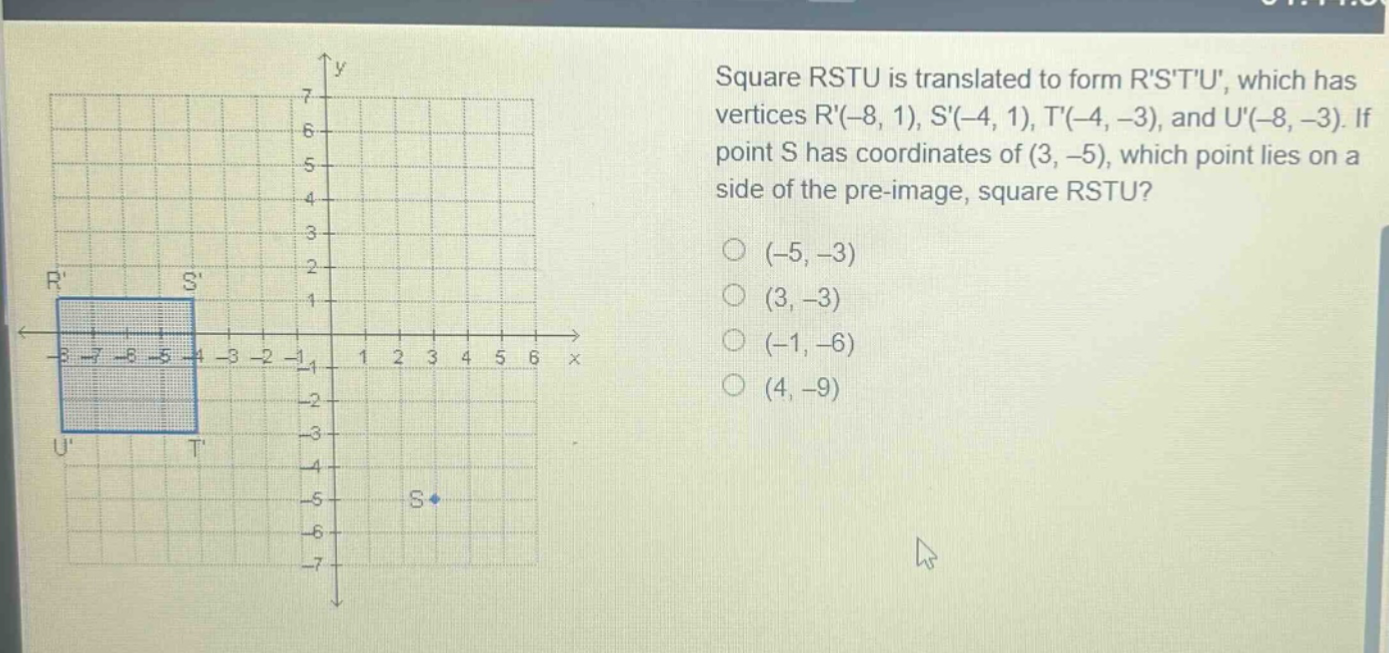
square rstu is translated to form rstu, which has vertices r(-8, 1), s(-4, 1), t(-4, -3), and u(-8, -3). if point s has coordinates of (3, -5), which point lies on a side of the pre - image, square rstu? (-5, -3) (3, -3) (-1, -6) (4, -9)
Answer
Explanation:
Step1: Find the translation rule
To find the translation rule, compare the coordinates of $S(3,-5)$ and $S'(-4,1)$. The change in $x$ - coordinate is $-4 - 3=-7$, and the change in $y$ - coordinate is $1-(-5)=6$. So the translation rule is $(x,y)\to(x - 7,y + 6)$.
Step2: Reverse the translation rule for the pre - image
To find points on the pre - image, we use the reverse rule $(x,y)\to(x + 7,y - 6)$.
Step3: Check each option
For option A: If we apply the reverse - translation to $(-5,-3)$, we get $(-5 + 7,-3-6)=(2,-9)$. For option B: If we apply the reverse - translation to $(3,-3)$, we get $(3 + 7,-3-6)=(10,-9)$. For option C: If we apply the reverse - translation to $(-1,-6)$, we get $(-1 + 7,-6-6)=(6,-12)$. For option D: If we apply the reverse - translation to $(4,-9)$, we get $(4 + 7,-9-6)=(11,-15)$. Let's find the side - length of the square. The distance between $S'(-4,1)$ and $T'(-4,-3)$ is $|1-(-3)| = 4$. The side of the square $RSTU$: We know that $S(3,-5)$. Consider the fact that in a square, we can use the properties of parallel and perpendicular lines. The vector from $S'$ to $T'$ is a vertical vector. In the pre - image, the sides are parallel to the sides of the image. The side of the square passing through $S(3,-5)$ has a vertical or horizontal relationship. The $x$ - coordinate of $S$ is $3$. A point on the side of the square should have either the same $x$ - coordinate or a $y$ - coordinate that is related to the side - length of the square. The side - length of the square in the image is $4$. If we consider a point on the side of the square passing through $S(3,-5)$, a possible point is $(3,-3)$ because the difference in the $y$ - coordinates $|-5-(-3)| = 2$ and it can be part of the square's side structure.
Answer:
$(3,-3)$