state the null and alternative hypotheses. at most 61% of americans vote in presidential elections. follow…
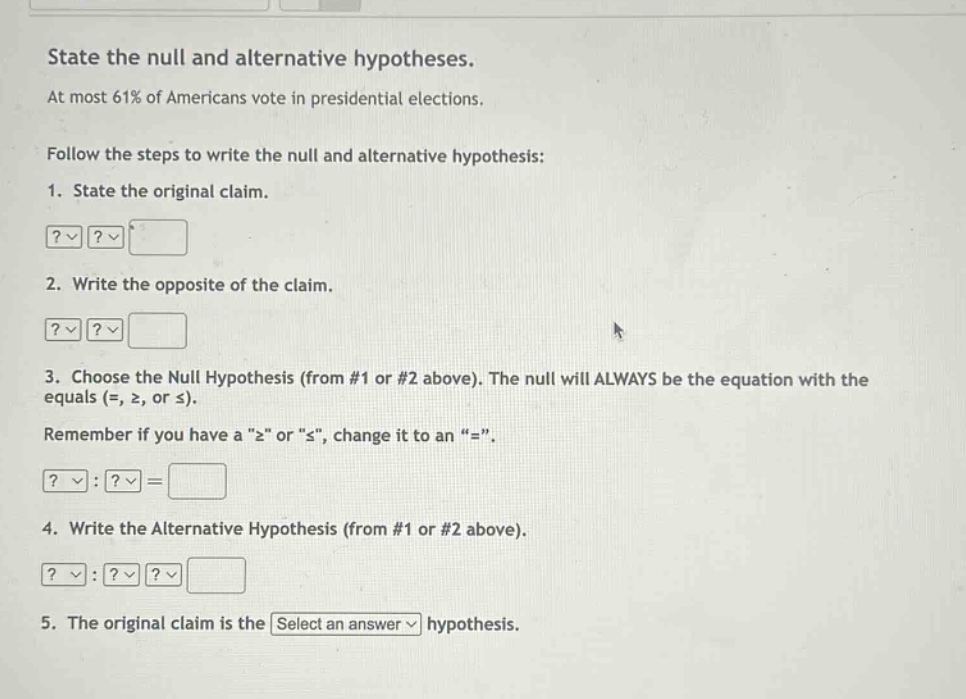
state the null and alternative hypotheses. at most 61% of americans vote in presidential elections. follow the steps to write the null and alternative hypothesis: 1. state the original claim. 2. write the opposite of the claim. 3. choose the null hypothesis (from #1 or #2 above). the null will always be the equation with the equals (=, ≥, or ≤). remember if you have a “≥” or “≤”, change it to an “=”. 4. write the alternative hypothesis (from #1 or #2 above). 5. the original claim is the select an answer hypothesis.
Answer
Explanation:
Step1: State the original claim
The original claim is that at most 61% of Americans vote in presidential elections. In symbolic form, $p\leq0.61$.
Step2: Write the opposite of the claim
The opposite of $p\leq0.61$ is $p > 0.61$.
Step3: Choose the Null Hypothesis
The null hypothesis $H_0$ is the one with the equality - like symbol. So, $H_0:p = 0.61$.
Step4: Write the Alternative Hypothesis
The alternative hypothesis $H_1$ is the non - equality statement. So, $H_1:p>0.61$.
Step5: Determine the original claim as a hypothesis
The original claim $p\leq0.61$ is part of the null hypothesis $H_0$.
Answer:
- Original claim: $p\leq0.61$
- Opposite of the claim: $p > 0.61$
- Null Hypothesis ($H_0$): $p = 0.61$
- Alternative Hypothesis ($H_1$): $p>0.61$
- The original claim is the null hypothesis.