which statement best compares the graphs of (f(x)=lfloor x\rfloor) and (f(x)=lceil x\rceil)?\nthe two graphs…
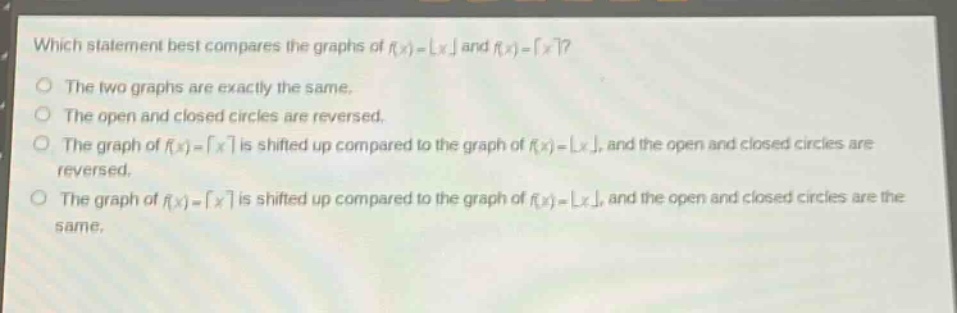
which statement best compares the graphs of (f(x)=lfloor x\rfloor) and (f(x)=lceil x\rceil)?\nthe two graphs are exactly the same.\nthe open and closed circles are reversed.\nthe graph of (f(x)=lceil x\rceil) is shifted up compared to the graph of (f(x)=lfloor x\rfloor), and the open and closed circles are reversed.\nthe graph of (f(x)=lceil x\rceil) is shifted up compared to the graph of (f(x)=lfloor x\rfloor), and the open and closed circles are the same.
Answer
Brief Explanations:
The function $f(x)=\lfloor x\rfloor$ is the floor - function which gives the greatest integer less than or equal to $x$. The function $f(x)=\lceil x\rceil$ is the ceiling - function which gives the smallest integer greater than or equal to $x$. For any non - integer value of $x$, the values of $\lfloor x\rfloor$ and $\lceil x\rceil$ differ by $1$ with $\lceil x\rceil=\lfloor x\rfloor + 1$. The graph of $y = \lceil x\rceil$ is shifted up by $1$ unit compared to the graph of $y=\lfloor x\rfloor$. Also, the open and closed circles (which represent the continuity and discontinuity points) are reversed. For example, for the floor function at integer values, the left - hand limit is equal to the function value (closed circle on the left - hand side of the integer) and for the ceiling function at integer values, the right - hand limit is equal to the function value (closed circle on the right - hand side of the integer).
Answer:
The graph of $f(x)=\lceil x\rceil$ is shifted up compared to the graph of $f(x)=\lfloor x\rfloor$, and the open and closed circles are reversed.