which statement best describes the domain and range of $p(x)=6^{-x}$ and $q(x)=6^{x}$?\n$p(x)$ and $q(x)$…
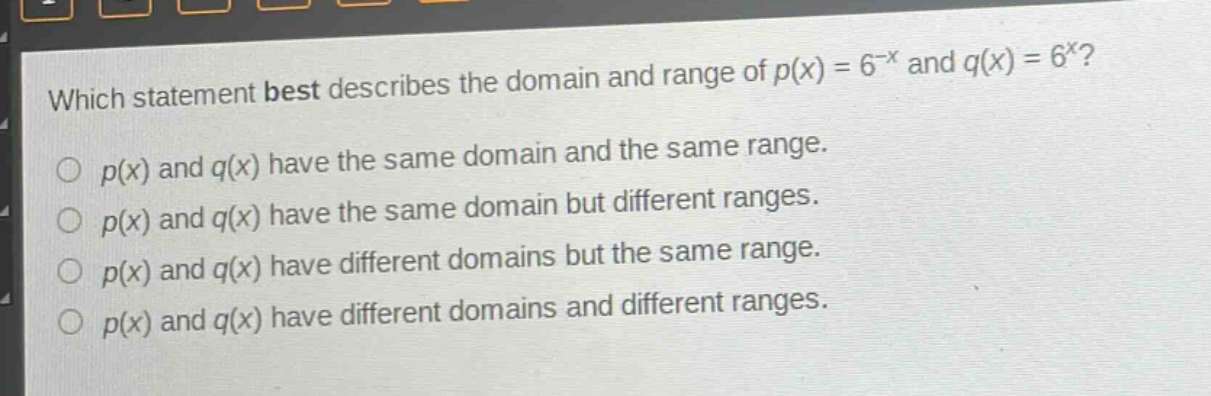
which statement best describes the domain and range of $p(x)=6^{-x}$ and $q(x)=6^{x}$?\n$p(x)$ and $q(x)$ have the same domain and the same range.\n$p(x)$ and $q(x)$ have the same domain but different ranges.\n$p(x)$ and $q(x)$ have different domains but the same range.\n$p(x)$ and $q(x)$ have different domains and different ranges.
Answer
Answer:
A. $p(x)$ and $q(x)$ have the same domain and the same range.
Explanation:
Step1: Determine the domain of $p(x)$
For $p(x)=6^{-x}=\left(\frac{1}{6}\right)^{x}$, $x$ can be any real - number. So the domain of $p(x)$ is $(-\infty,\infty)$.
Step2: Determine the domain of $q(x)$
For $q(x)=6^{x}$, $x$ can be any real - number. So the domain of $q(x)$ is $(-\infty,\infty)$. Thus, they have the same domain.
Step3: Determine the range of $p(x)$
Since for any real $x$, $\left(\frac{1}{6}\right)^{x}>0$, the range of $p(x)$ is $(0,\infty)$.
Step4: Determine the range of $q(x)$
Since for any real $x$, $6^{x}>0$, the range of $q(x)$ is $(0,\infty)$. Thus, they have the same range.