which statement best describes the domain and range of $f(x)=-(7)^{x}$ and $g(x)=7^{x}$?\n$f(x)$ and $g(x)$…
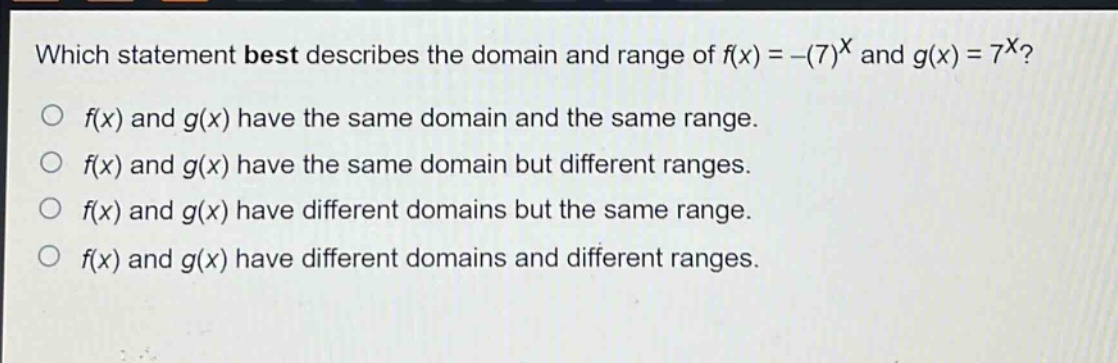
which statement best describes the domain and range of $f(x)=-(7)^{x}$ and $g(x)=7^{x}$?\n$f(x)$ and $g(x)$ have the same domain and the same range.\n$f(x)$ and $g(x)$ have the same domain but different ranges.\n$f(x)$ and $g(x)$ have different domains but the same range.\n$f(x)$ and $g(x)$ have different domains and different ranges.
Answer
Explanation:
Step1: Determine the domain of (f(x))
For the exponential - function (f(x)=-(7)^{x}), (x) can be any real number. So the domain of (f(x)) is ((-\infty,\infty)).
Step2: Determine the domain of (g(x))
For the exponential - function (g(x) = 7^{x}), (x) can be any real number. So the domain of (g(x)) is ((-\infty,\infty)). Thus, (f(x)) and (g(x)) have the same domain.
Step3: Determine the range of (f(x))
Since (7^{x}>0) for all real (x), then (f(x)=-(7)^{x}<0). So the range of (f(x)) is ((-\infty,0)).
Step4: Determine the range of (g(x))
Since (7^{x}>0) for all real (x), the range of (g(x)) is ((0,\infty)). So (f(x)) and (g(x)) have different ranges.
Answer:
(f(x)) and (g(x)) have the same domain but different ranges.