which statement best describes the domain and range of (f(x)=-(7)^{x}) and (g(x)=7^{x})?\n(f(x)) and (g(x))…
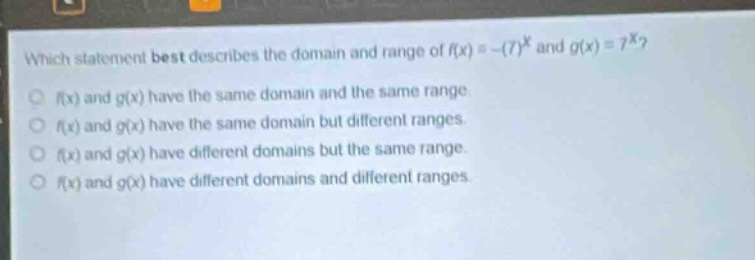
which statement best describes the domain and range of (f(x)=-(7)^{x}) and (g(x)=7^{x})?\n(f(x)) and (g(x)) have the same domain and the same range.\n(f(x)) and (g(x)) have the same domain but different ranges.\n(f(x)) and (g(x)) have different domains but the same range.\n(f(x)) and (g(x)) have different domains and different ranges.
Answer
Explanation:
Step1: Determine the domain of (f(x)=-(7)^{x}) and (g(x) = 7^{x})
The exponential - function (y = a^{x}), where (a>0,a\neq1), is defined for all real - numbers. For (f(x)=-(7)^{x}) and (g(x)=7^{x}), the domain of both functions is the set of all real numbers, ((-\infty,\infty)).
Step2: Determine the range of (f(x)=-(7)^{x}) and (g(x)=7^{x})
For the function (g(x)=7^{x}), since (7>1), as (x\to-\infty), (g(x)\to0) (but (g(x)>0)), and as (x\to\infty), (g(x)\to\infty). So the range of (g(x)) is ((0,\infty)). For the function (f(x)=-(7)^{x}), as (x\to-\infty), (f(x)\to0) (but (f(x)<0)), and as (x\to\infty), (f(x)\to-\infty). So the range of (f(x)) is ((-\infty,0)).
Answer:
(f(x)) and (g(x)) have the same domain but different ranges.