which statement best describes the effect on the graph of $y=(x - 9)^2$ if the equation is changed to $y=(x…
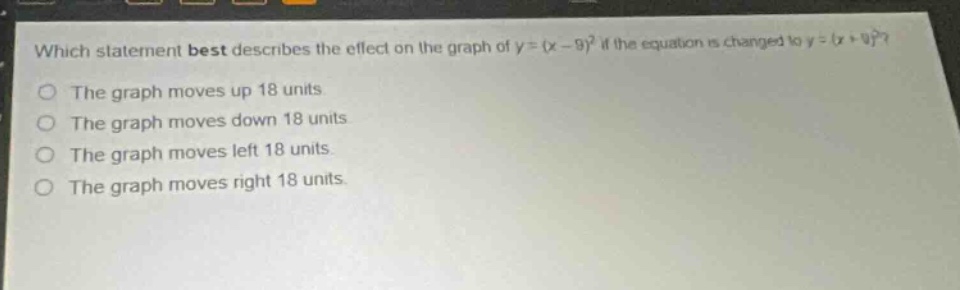
which statement best describes the effect on the graph of $y=(x - 9)^2$ if the equation is changed to $y=(x + 9)^2$?\nthe graph moves up 18 units.\nthe graph moves down 18 units.\nthe graph moves left 18 units.\nthe graph moves right 18 units.
Answer
Explanation:
Step1: Recall transformation rule
For a function $y = f(x - h)$, a change to $y = f(x + k)$ ($k>0$) is a horizontal shift. The general rule for horizontal shifts of the graph of $y = f(x)$ is that $y=f(x - h)$ shifts the graph of $y = f(x)$ to the right by $h$ units and $y=f(x + h)$ shifts it to the left by $h$ units.
Step2: Analyze given functions
We have $y=(x - 9)^2$ and $y=(x+9)^2$. The change from $x-9$ to $x + 9$ means $x$ is replaced by $x+18$ (since $x-9$ becomes $x+9$ when we add 18 to $x$). According to the horizontal - shift rule, when we change from $y=(x - 9)^2$ to $y=(x + 9)^2$, the graph of the function moves left 18 units.
Answer:
The graph moves left 18 units.