which statement best describes $g(x)=sqrt3{x + 6}-8$ and the parent function $f(x)=sqrt3{x}$?\nthe domains…
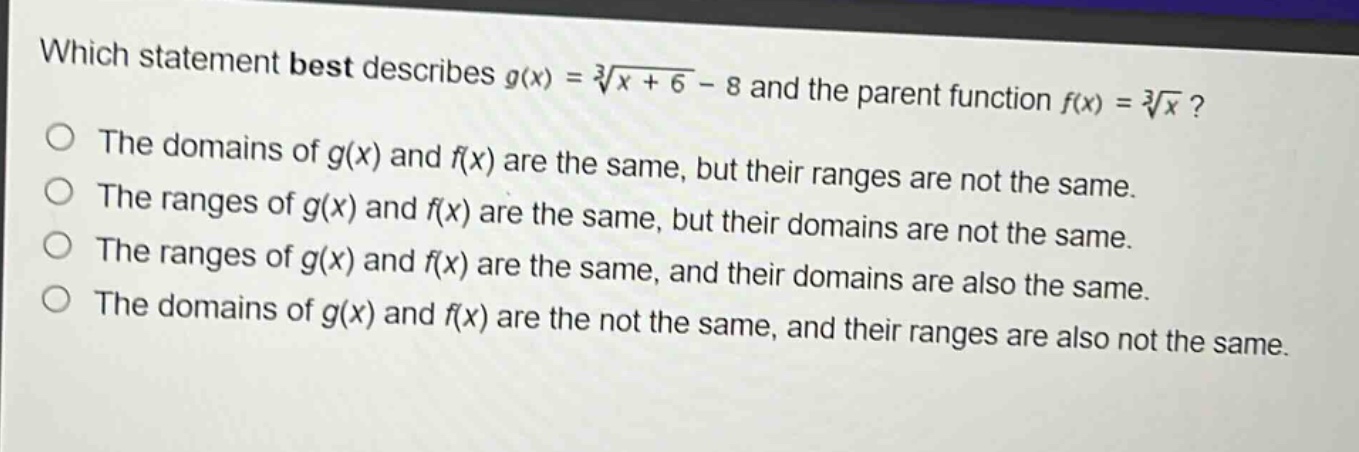
which statement best describes $g(x)=sqrt3{x + 6}-8$ and the parent function $f(x)=sqrt3{x}$?\nthe domains of $g(x)$ and $f(x)$ are the same, but their ranges are not the same.\nthe ranges of $g(x)$ and $f(x)$ are the same, but their domains are not the same.\nthe ranges of $g(x)$ and $f(x)$ are the same, and their domains are also the same.\nthe domains of $g(x)$ and $f(x)$ are the not the same, and their ranges are also not the same.
Answer
Explanation:
Step1: Find domain of (f(x)=\sqrt[3]{x})
The cube - root function (y = \sqrt[3]{x}) is defined for all real numbers. So, the domain of (f(x)) is ((-\infty,\infty)).
Step2: Find domain of (g(x)=\sqrt[3]{x + 6}-8)
The expression inside the cube - root (x+6) can be any real number. Solving (x+6\in R), we get (x\in(-\infty,\infty)). So the domain of (g(x)) is ((-\infty,\infty)).
Step3: Find range of (f(x)=\sqrt[3]{x})
The cube - root function (y=\sqrt[3]{x}) can output any real number. So the range of (f(x)) is ((-\infty,\infty)).
Step4: Find range of (g(x)=\sqrt[3]{x + 6}-8)
Since (\sqrt[3]{x + 6}) can be any real number, and (y=\sqrt[3]{x + 6}-8), then (y\in(-\infty,\infty)). So the range of (g(x)) is ((-\infty,\infty)).
Answer:
The ranges of (g(x)) and (f(x)) are the same, and their domains are also the same.