which statement about the binomial expansion of $(x^{2}-x)^{9}$ is true?\nthe first term is $-x^{18}$.\nthe…
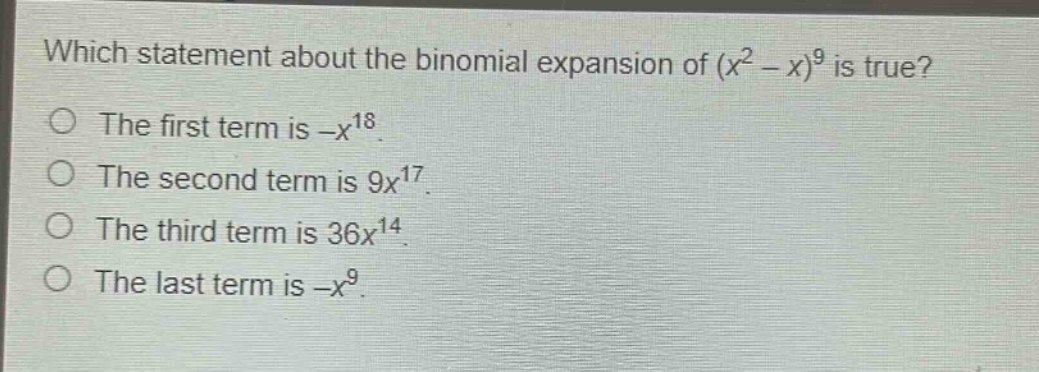
which statement about the binomial expansion of $(x^{2}-x)^{9}$ is true?\nthe first term is $-x^{18}$.\nthe second term is $9x^{17}$.\nthe third term is $36x^{14}$.\nthe last term is $-x^{9}$.
Answer
Answer:
D. The last term is $-x^{9}$.
Explanation:
Step1: Recall binomial theorem formula
The binomial expansion of $(a + b)^n=\sum_{k = 0}^{n}\binom{n}{k}a^{n - k}b^{k}$. For $(x^{2}-x)^{9}$, we have $a=x^{2}$, $b=-x$ and $n = 9$.
Step2: Find the general - term formula
The general term $T_{k + 1}=\binom{9}{k}(x^{2})^{9 - k}(-x)^{k}=\binom{9}{k}x^{18-2k}(-1)^{k}x^{k}=\binom{9}{k}(-1)^{k}x^{18 - 2k + k}=\binom{9}{k}(-1)^{k}x^{18 - k}$.
Step3: Analyze the first - term
When $k = 0$, $T_{1}=\binom{9}{0}(-1)^{0}x^{18-0}=x^{18}$, so option A is false.
Step4: Analyze the second - term
When $k = 1$, $T_{2}=\binom{9}{1}(-1)^{1}x^{18 - 1}=9\times(-1)x^{17}=-9x^{17}$, so option B is false.
Step5: Analyze the third - term
When $k = 2$, $T_{3}=\binom{9}{2}(-1)^{2}x^{18-2}=\frac{9!}{2!(9 - 2)!}\times1\times x^{16}=\frac{9\times8}{2\times1}x^{16}=36x^{16}$, so option C is false.
Step6: Analyze the last - term
When $k = 9$, $T_{10}=\binom{9}{9}(-1)^{9}x^{18 - 9}=1\times(-1)x^{9}=-x^{9}$, so option D is true.