which statement describes the graph of $f(x)=4x^{2}+20x + 25$?\nthe graph does not intersect the x…
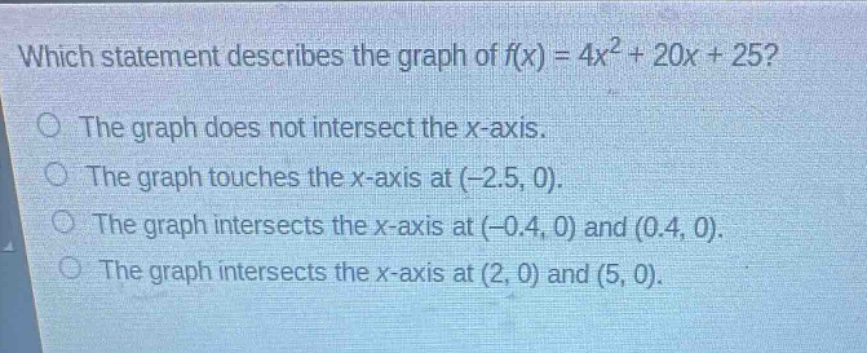
which statement describes the graph of $f(x)=4x^{2}+20x + 25$?\nthe graph does not intersect the x - axis.\nthe graph touches the x - axis at (-2.5, 0).\nthe graph intersects the x - axis at (-0.4, 0) and (0.4, 0).\nthe graph intersects the x - axis at (2, 0) and (5, 0).
Answer
Explanation:
Step1: Determine the discriminant
For a quadratic function $y = ax^{2}+bx + c$, the discriminant is $\Delta=b^{2}-4ac$. Here, $a = 4$, $b = 20$, and $c = 25$. So, $\Delta=(20)^{2}-4\times4\times25$.
Step2: Calculate the discriminant value
$\Delta = 400 - 400=0$. When $\Delta = 0$, the quadratic - function has exactly one real root.
Step3: Find the root of the quadratic function
We can find the root using the quadratic formula $x=\frac{-b\pm\sqrt{\Delta}}{2a}$. Since $\Delta = 0$, $x=\frac{-20\pm\sqrt{0}}{2\times4}=\frac{-20}{8}=-2.5$.
Answer:
The graph touches the x - axis at $(-2.5,0)$.