which statement describes the graph of $f(x)=4x^{7}+40x^{6}+100x^{5}$?\nthe graph crosses the x - axis at x…
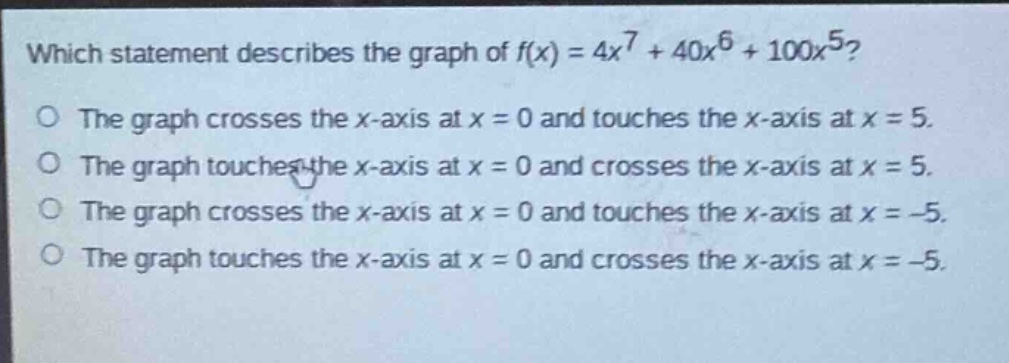
which statement describes the graph of $f(x)=4x^{7}+40x^{6}+100x^{5}$?\nthe graph crosses the x - axis at x = 0 and touches the x - axis at x = 5.\nthe graph touches the x - axis at x = 0 and crosses the x - axis at x = 5.\nthe graph crosses the x - axis at x = 0 and touches the x - axis at x = - 5.\nthe graph touches the x - axis at x = 0 and crosses the x - axis at x = - 5.
Answer
Answer:
C. The graph crosses the x - axis at x = 0 and touches the x - axis at x = - 5.
Explanation:
Step1: Factor the polynomial
First, factor out the greatest - common factor from (f(x)=4x^{7}+40x^{6}+100x^{5}). The GCF is (4x^{5}), so (f(x)=4x^{5}(x^{2} + 10x + 25)).
Step2: Factor the quadratic
Factor the quadratic (x^{2}+10x + 25=(x + 5)^{2}). Then (f(x)=4x^{5}(x + 5)^{2}).
Step3: Analyze the roots
The roots of the function are found by setting (f(x)=0). So (4x^{5}(x + 5)^{2}=0). The roots are (x = 0) and (x=-5). For a root (x = a) of a polynomial (y = P(x)), if the exponent of the factor ((x - a)) is odd, the graph crosses the x - axis at (x = a), and if the exponent of the factor ((x - a)) is even, the graph touches the x - axis at (x = a). The exponent of (x) (or ((x-0))) is 5 (odd), so the graph crosses the x - axis at (x = 0). The exponent of ((x + 5)) (or ((x-(-5)))) is 2 (even), so the graph touches the x - axis at (x=-5).