which statement describes the roots of this equation?\n1 rational root and 2 complex roots\n1 rational root…
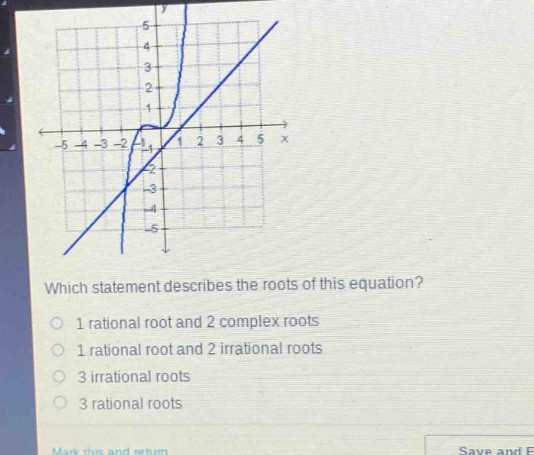
which statement describes the roots of this equation?\n1 rational root and 2 complex roots\n1 rational root and 2 irrational roots\n3 irrational roots\n3 rational roots
Answer
Explanation:
Step1: Analyze the graph - degree
The graph of a polynomial function crosses or touches the x - axis at its roots. The degree of the polynomial can be inferred from the number of times the graph intersects the x - axis and its behavior. Since the graph intersects the x - axis at 3 points, the polynomial is of degree 3.
Step2: Recall root - type properties
A polynomial of degree 3 has 3 roots (counting multiplicities). Rational roots are roots that can be written as a fraction $\frac{p}{q}$ where $p$ and $q$ are integers and $q\neq0$. Irrational roots cannot be written as a fraction and often involve square - roots, cube - roots etc. Complex roots of a polynomial with real coefficients come in conjugate pairs. Since the graph crosses the x - axis at 3 distinct points, all the roots are real. And from the shape of the graph, we can see that one of the roots is at $x = 0$ (a rational root), and the other two roots are non - rational (irrational) as they do not land on integer or simple fraction values on the x - axis.
Answer:
1 rational root and 2 irrational roots