which statement about the following equation is true?\n2x² - 9x + 2 = -1\nthe discriminant is less than 0…
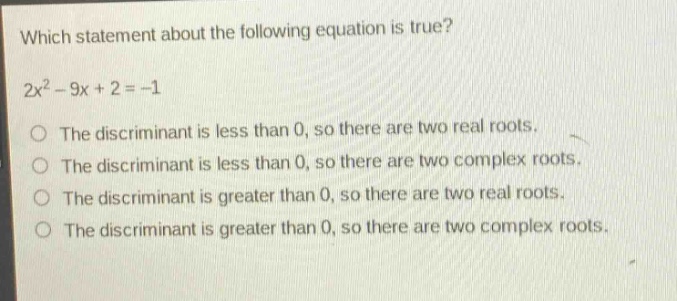
which statement about the following equation is true?\n2x² - 9x + 2 = -1\nthe discriminant is less than 0, so there are two real roots.\nthe discriminant is less than 0, so there are two complex roots.\nthe discriminant is greater than 0, so there are two real roots.\nthe discriminant is greater than 0, so there are two complex roots.
Answer
Explanation:
Step1: Rewrite the equation in standard form
The standard form of a quadratic equation is (ax^{2}+bx + c=0). Given (2x^{2}-9x + 2=-1), add (1) to both sides: (2x^{2}-9x+3 = 0) Here (a = 2), (b=-9), (c = 3)
Step2: Calculate the discriminant
The discriminant formula is (\Delta=b^{2}-4ac) Substitute (a = 2), (b=-9), (c = 3) into the formula: (\Delta=(-9)^{2}-4\times2\times3) (=81 - 24) (=57)
Step3: Determine the nature of the roots
Since (\Delta=57>0), when (\Delta>0), the quadratic equation (ax^{2}+bx + c = 0) has two distinct real roots.
Answer:
The discriminant is greater than 0, so there are two real roots.