which statement about the polynomial function g(x) is true?\nif all rational roots of g(x) = 0 are integers…
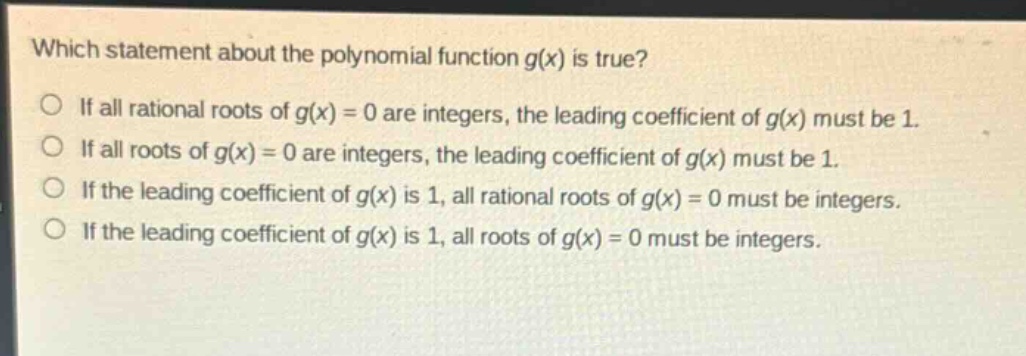
which statement about the polynomial function g(x) is true?\nif all rational roots of g(x) = 0 are integers, the leading coefficient of g(x) must be 1.\nif all roots of g(x) = 0 are integers, the leading coefficient of g(x) must be 1.\nif the leading coefficient of g(x) is 1, all rational roots of g(x) = 0 must be integers.\nif the leading coefficient of g(x) is 1, all roots of g(x) = 0 must be integers.
Answer
Answer:
If the leading coefficient of (g(x)) is 1, all rational roots of (g(x)=0) must be integers.
Explanation:
Step1: Teorema de las raíces racionales
El teorema de las raíces racionales dice que para un polinomio (a_nx^n + a_{n - 1}x^{n-1}+\cdots+a_1x + a_0=0) con coeficientes enteros (a_i), las raíces racionales (p/q) satisfacen que (p) es un divisor del término independiente (a_0) y (q) es un divisor del coeficiente principal (a_n).
Step2: Caso coeficiente principal 1
Si (a_n = 1), entonces (q = 1) (ya que los divisores de 1 son 1 y - 1). Entonces, cualquier raíz racional (p/q) se convierte en (p), que es un entero.
Step3: Analizar otras opciones
- Si todas las raíces racionales son enteras, no es necesario que el coeficiente principal sea 1. Por ejemplo, (2x^2-2 = 2(x - 1)(x + 1)) tiene raíces racionales enteras pero coeficiente principal 2.
- Si todas las raíces son enteras (incluyendo posibles raíces irracionales o complejas), no implica que el coeficiente principal sea 1.
- Si el coeficiente principal es 1, no se asegura que todas las raíces (que pueden ser irracionales o complejas) sean enteras, solo las raíces racionales.