how can the statement be rewritten as a conditional statement in if - then form? a rectangle with 4…
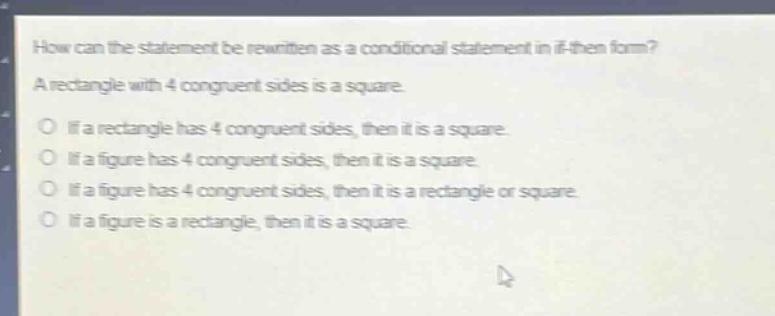
how can the statement be rewritten as a conditional statement in if - then form? a rectangle with 4 congruent sides is a square. if a rectangle has 4 congruent sides, then it is a square. if a figure has 4 congruent sides, then it is a square. if a figure has 4 congruent sides, then it is a rectangle or square. if a figure is a rectangle, then it is a square.
Answer
Brief Explanations:
A conditional statement in if - then form has a hypothesis (the part after 'if') and a conclusion (the part after 'then'). The original statement defines a square as a rectangle with 4 congruent sides. So the correct if - then form should have the condition of a rectangle having 4 congruent sides as the hypothesis and it being a square as the conclusion.
Answer:
If a rectangle has 4 congruent sides, then it is a square.