if the statement shown is rewritten as a conditional statement in if - then form, which best describes the…
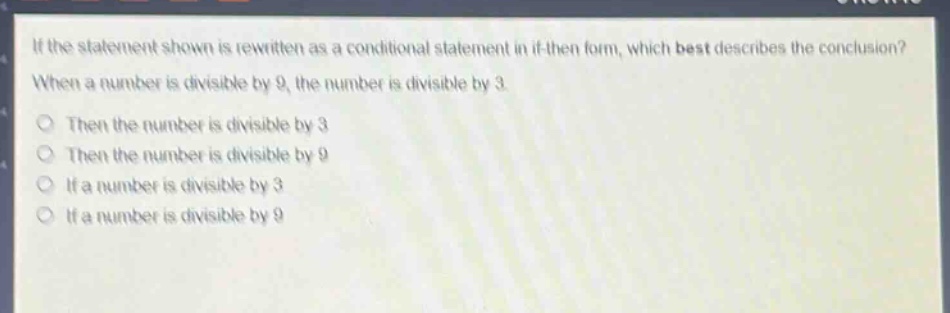
if the statement shown is rewritten as a conditional statement in if - then form, which best describes the conclusion? when a number is divisible by 9, the number is divisible by 3. then the number is divisible by 3 then the number is divisible by 9 if a number is divisible by 3 if a number is divisible by 9
Answer
Explanation:
Step1: Recall conditional - statement form
A conditional statement is in the form "if p, then q", where p is the hypothesis and q is the conclusion.
Step2: Identify hypothesis and conclusion
The statement "When a number is divisible by 9, the number is divisible by 3" can be rewritten as "If a number is divisible by 9, then the number is divisible by 3". Here, the hypothesis p is "a number is divisible by 9" and the conclusion q is "the number is divisible by 3".
Answer:
Then the number is divisible by 3