which statement is true about the equations -3x + 4y = 12 and $\frac{1}{4}x-\frac{1}{3}y = 1$?\nthe system…
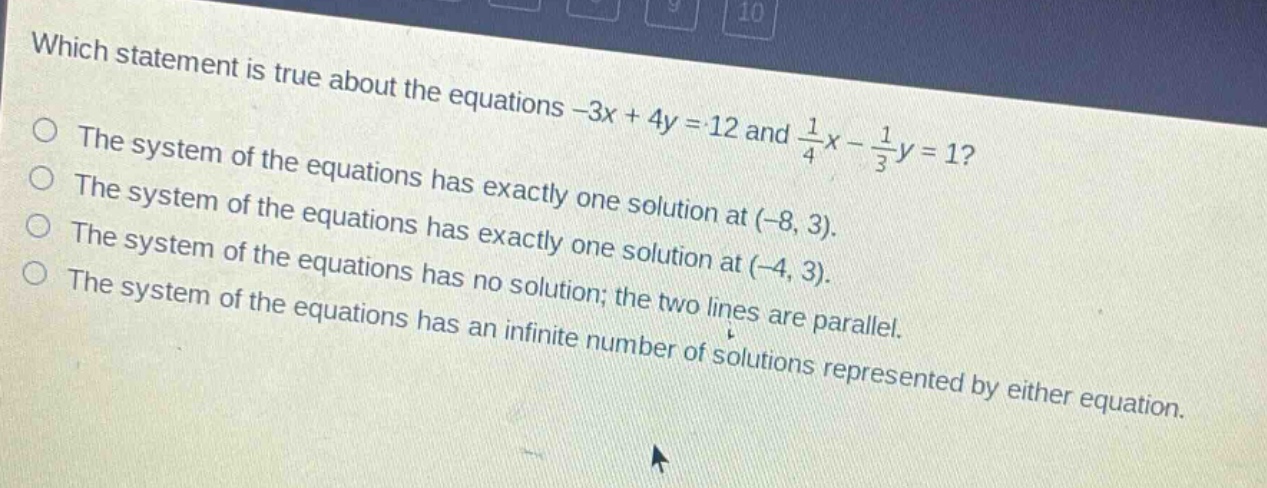
which statement is true about the equations -3x + 4y = 12 and $\frac{1}{4}x-\frac{1}{3}y = 1$?\nthe system of the equations has exactly one solution at (-8, 3).\nthe system of the equations has exactly one solution at (-4, 3).\nthe system of the equations has no solution; the two lines are parallel.\nthe system of the equations has an infinite number of solutions represented by either equation.
Answer
Explanation:
Step1: Rewrite the second - equation
Multiply the second equation $\frac{1}{4}x-\frac{1}{3}y = 1$ by 12 to get $3x - 4y=12$. The first equation is $-3x + 4y = 12$, which can be rewritten as $3x-4y=- 12$.
Step2: Analyze the slopes and intercepts
For a linear equation in the form $Ax + By=C$, the slope is $m=-\frac{A}{B}$. For the equation $3x - 4y=-12$ (or $y=\frac{3}{4}x + 3$), and $3x - 4y = 12$ (or $y=\frac{3}{4}x-3$). The slopes of the two lines are equal ($m_1 = m_2=\frac{3}{4}$), but the y - intercepts are different ($b_1 = 3$ and $b_2=-3$). Parallel lines have the same slope and different y - intercepts, so the system has no solution.
Answer:
The system of the equations has no solution; the two lines are parallel.