which statement is true about $f(x)=-\frac{2}{3}|x + 4|-6$?\nthe graph of $f(x)$ has a vertex of…
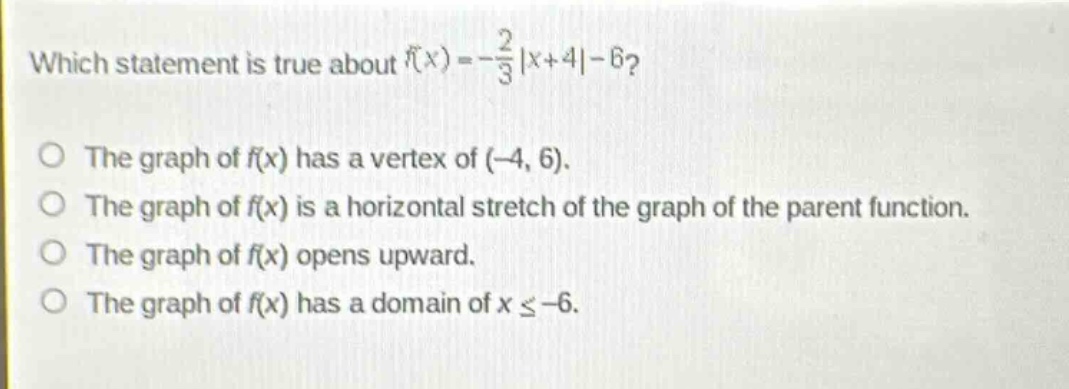
which statement is true about $f(x)=-\frac{2}{3}|x + 4|-6$?\nthe graph of $f(x)$ has a vertex of $(-4,6)$.\nthe graph of $f(x)$ is a horizontal stretch of the graph of the parent function.\nthe graph of $f(x)$ opens upward.\nthe graph of $f(x)$ has a domain of $xleq - 6$.
Answer
Explanation:
Step1: Recall vertex - form of absolute - value function
The general form of an absolute - value function is $y = a|x - h|+k$, and its vertex is $(h,k)$. For the function $f(x)=-\frac{2}{3}|x + 4|-6$, we can rewrite it as $f(x)=-\frac{2}{3}|x-(-4)|-6$. So the vertex is $(-4,-6)$, not $(-4,6)$.
Step2: Analyze horizontal stretch
The coefficient $a =-\frac{2}{3}$ in $y = a|x - h|+k$ affects the vertical stretch or compression and reflection. There is no horizontal stretch factor in the form $y = a|x - h|+k$ for an absolute - value function. The horizontal transformation is given by the value of $h$.
Step3: Determine the direction of opening
Since $a=-\frac{2}{3}<0$, the graph of the absolute - value function $y = a|x - h|+k$ opens downward. If $a>0$, it opens upward.
Step4: Find the domain of the function
The domain of an absolute - value function $y = a|x - h|+k$ is all real numbers, because we can substitute any real number for $x$. That is, the domain of $f(x)=-\frac{2}{3}|x + 4|-6$ is $(-\infty,\infty)$ or $x\in R$.
None of the given statements are true. But if we assume we need to correct the statements: The correct statement about the function $f(x)=-\frac{2}{3}|x + 4|-6$ is that it has a vertex of $(-4,-6)$.