which statement is true about (f(x)=-6|x + 5|-2)?\nthe graph of (f(x)) is a horizontal compression of the…
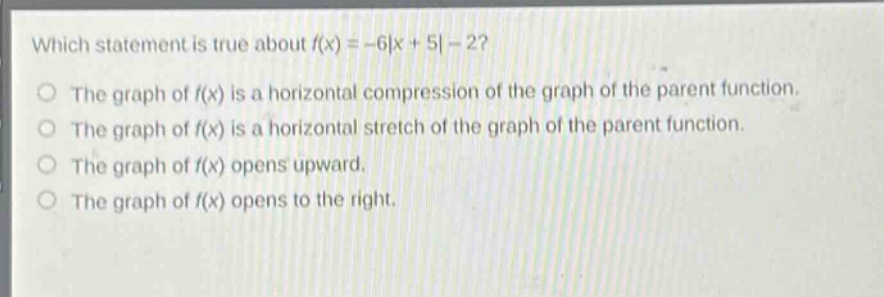
which statement is true about (f(x)=-6|x + 5|-2)?\nthe graph of (f(x)) is a horizontal compression of the graph of the parent function.\nthe graph of (f(x)) is a horizontal stretch of the graph of the parent function.\nthe graph of (f(x)) opens upward.\nthe graph of (f(x)) opens to the right.
Answer
Explanation:
Step1: Identify the parent - function
The parent - function of (y = a|x - h|+k) is (y = |x|). For the function (f(x)=-6|x + 5|-2), where (a=-6), (h=-5), and (k = - 2).
Step2: Analyze the effect of (a) on the graph
The value of (a) in the absolute - value function (y=a|x - h|+k) determines the vertical stretch/compression and the direction of opening. If (|a|>1), the graph is vertically stretched, and if (0<|a|<1), the graph is vertically compressed. Also, if (a>0), the graph opens upward, and if (a < 0), the graph opens downward. Here, (a=-6), so the graph is vertically stretched and opens downward. There is no horizontal stretch or compression related to the value of (a) in the form (y = a|x - h|+k). The graph of an absolute - value function (y=a|x - h|+k) does not open to the right or left; it opens upward or downward.
Answer:
None of the given statements are true.