which statement is true about the graphed function? o f(x) < 0 over the intervals (-∞, -0.7) and (0.76…
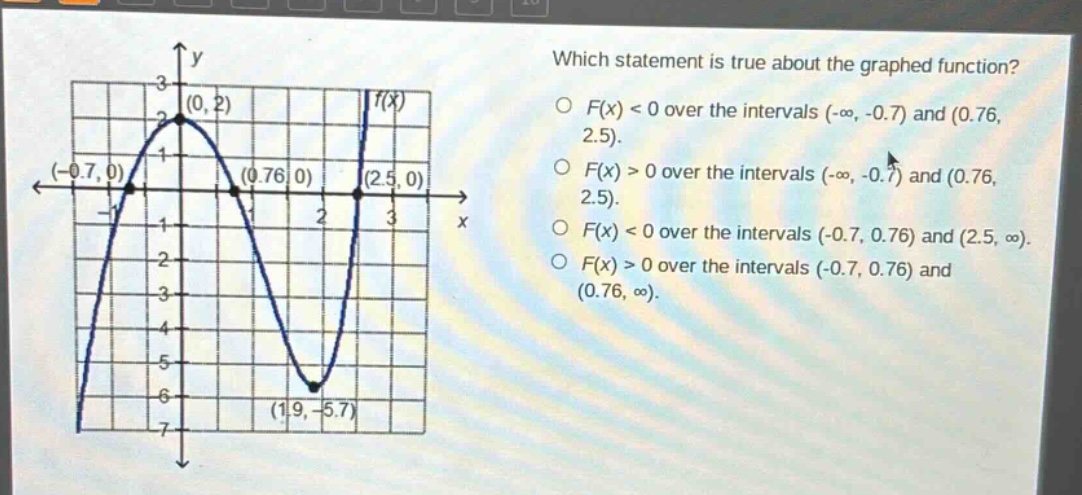
which statement is true about the graphed function? o f(x) < 0 over the intervals (-∞, -0.7) and (0.76, 2.5). o f(x) > 0 over the intervals (-∞, -0.7) and (0.76, 2.5). o f(x) < 0 over the intervals (-0.7, 0.76) and (2.5, ∞). o f(x) > 0 over the intervals (-0.7, 0.76) and (0.76, ∞).
Answer
Explanation:
Step1: Analyze the x - intercepts
The x - intercepts are $x=-0.7$, $x = 0.76$ and $x=2.5$.
Step2: Determine where $F(x)<0$ and $F(x)>0$
The function $F(x)$ is below the x - axis (i.e., $F(x)<0$) when $x\in(-0.7,0.76)\cup(2.5,\infty)$ and above the x - axis (i.e., $F(x)>0$) when $x\in(-\infty,-0.7)\cup(0.76,2.5)$.
Answer:
$F(x)<0$ over the intervals $(-0.7,0.76)$ and $(2.5,\infty)$