which statement is true?\n$y = \\log_{10}x$ is not a logarithmic function because the base is greater than…
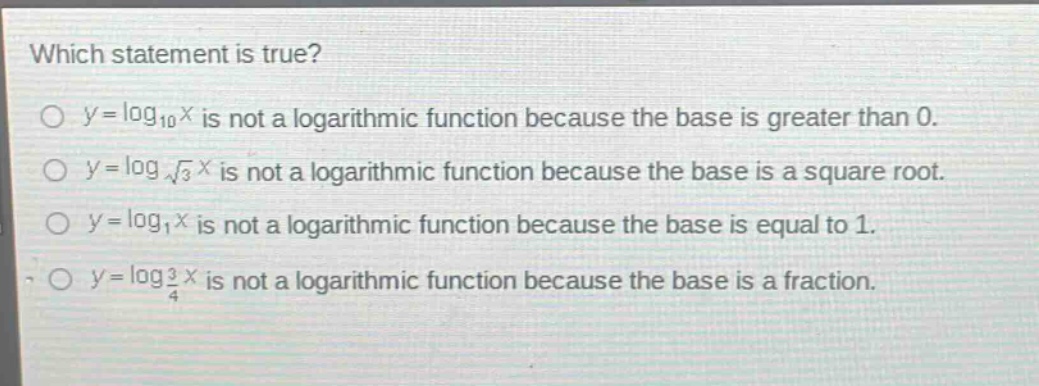
which statement is true?\n$y = \\log_{10}x$ is not a logarithmic function because the base is greater than 0.\n$y = \\log_{\\sqrt{3}}x$ is not a logarithmic function because the base is a square root.\n$y = \\log_{1}x$ is not a logarithmic function because the base is equal to 1.\n$y = \\log_{\\frac{3}{4}}x$ is not a logarithmic function because the base is a fraction.
Answer
Explanation:
Step1: Recall the definition of a logarithmic function
A logarithmic function is of the form (y = \log_{a}x), where (a>0), (a\neq1), and (x > 0).
Step2: Analyze each option
- For (y=\log_{10}x): The base (a = 10>0) and (a\neq1), so it is a logarithmic function.
- For (y=\log_{\sqrt{3}}x): The base (a=\sqrt{3}>0) and (a\neq1), so it is a logarithmic function.
- For (y=\log_{1}x): The base (a = 1). Since in the definition of (y=\log_{a}x) we require (a\neq1), this is not a logarithmic function.
- For (y=\log_{\frac{3}{4}}x): The base (a=\frac{3}{4}>0) and (a\neq1), so it is a logarithmic function.
Answer:
(y = \log_{1}x) is not a logarithmic function because the base is equal to 1.