which statement is true about the prime polynomial 2x² + 3x + 3? it cannot be modeled with a rectangle. it…
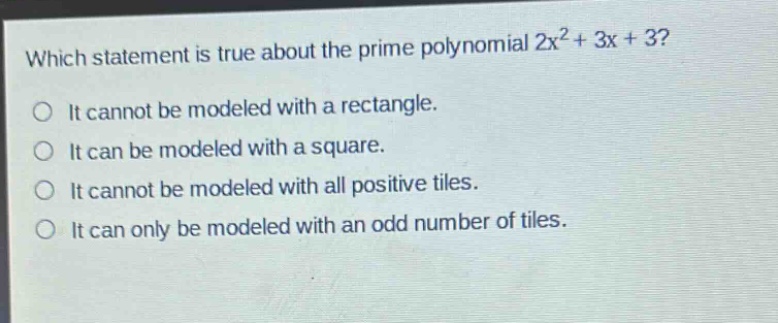
which statement is true about the prime polynomial 2x² + 3x + 3? it cannot be modeled with a rectangle. it can be modeled with a square. it cannot be modeled with all positive tiles. it can only be modeled with an odd number of tiles.
Answer
Explanation:
Step1: Recall polynomial - area model concept
In an area - model for a polynomial (ax^{2}+bx + c), we consider the polynomial as the area of a rectangle. The factors of the polynomial represent the side - lengths of the rectangle. A prime polynomial cannot be factored into two non - constant polynomials. If a polynomial cannot be factored, it cannot be represented as the area of a rectangle with polynomial side - lengths.
Step2: Analyze each option
- Option 1: A prime polynomial cannot be factored into two non - constant polynomials. In the context of area models for polynomials, factoring a polynomial (ax^{2}+bx + c) gives the side - lengths of a rectangle such that (ax^{2}+bx + c=(mx + n)(px+q)). Since (2x^{2}+3x + 3) is prime, it cannot be modeled as a rectangle.
- Option 2: A polynomial that can be modeled as a square must be a perfect - square trinomial of the form ((ax + b)^{2}=a^{2}x^{2}+2abx + b^{2}). The polynomial (2x^{2}+3x + 3) is not a perfect - square trinomial.
- Option 3: We can model (2x^{2}+3x + 3) with positive tiles. We can use 2 (x^{2}) - tiles, 3 (x) - tiles, and 3 unit tiles.
- Option 4: We can model the polynomial (2x^{2}+3x + 3) with (2 + 3+3=8) (an even number) of tiles.
Answer:
It cannot be modeled with a rectangle.