which statement could be used to explain why the function h(x) = x³ has an inverse relation that is also a…
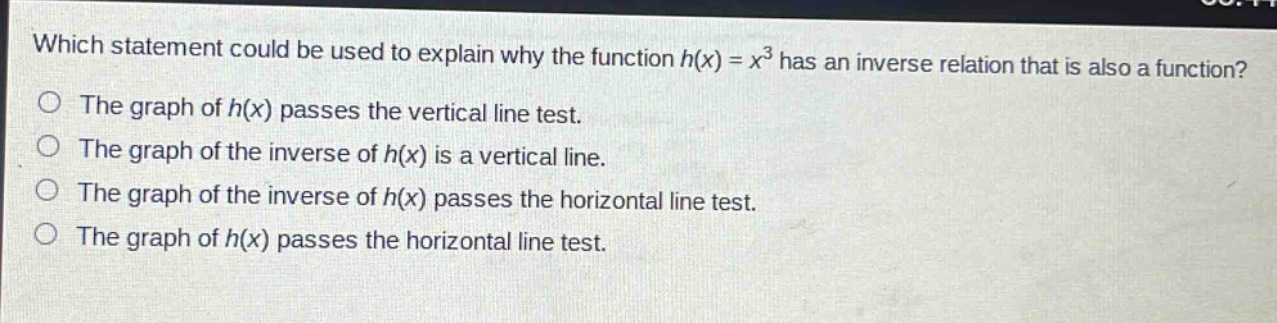
which statement could be used to explain why the function h(x) = x³ has an inverse relation that is also a function?\nthe graph of h(x) passes the vertical line test.\nthe graph of the inverse of h(x) is a vertical line.\nthe graph of the inverse of h(x) passes the horizontal line test.\nthe graph of h(x) passes the horizontal line test.
Answer
Answer:
D. The graph of (h(x)) passes the horizontal line test.
Explanation:
Step1: Recall function - inverse function concept
A function (y = f(x)) has an inverse that is also a function if and only if (f(x)) is one - to - one.
Step2: Understand line tests
The vertical line test is used to determine if a relation is a function. A horizontal line test is used to determine if a function is one - to - one.
Step3: Analyze the function (h(x)=x^{3})
For the function (h(x)=x^{3}), if we want its inverse to be a function, (h(x)) must be one - to - one. The graph of (h(x)=x^{3}) passes the horizontal line test, which means for every (y) value there is exactly one (x) value. So its inverse relation is also a function.