which statements are always true regarding the diagram? select three options.\n□m∠5 + m∠3 = m∠4\n□m∠3 + m∠4…
which statements are always true regarding the diagram? select three options.\n□m∠5 + m∠3 = m∠4\n□m∠3 + m∠4 + m∠5 = 180°\n□m∠5 + m∠6 = 180°\n□m∠2 + m∠3 = m∠6\n□m∠2 + m∠3 + m∠5 = 180°
Answer
Explanation:
Step1: Evaluate the statement $m\angle 5 + m\angle 6 = 180^\circ$.
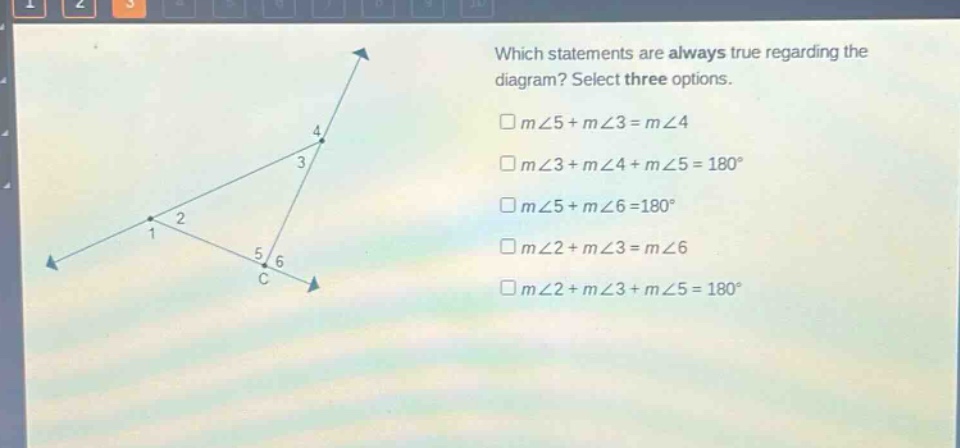
Angles 5 and 6 form a linear pair, meaning they are adjacent angles formed by intersecting lines, and their non-common sides are opposite rays. Linear pairs are supplementary. $$m\angle 5 + m\angle 6 = 180^\circ$$ This statement is true.
Step2: Evaluate the statement $m\angle 2 + m\angle 3 = m\angle 6$.
Angle 6 is an exterior angle to the triangle whose interior angles are $\angle 2$, $\angle 3$, and $\angle 5$. The Exterior Angle Theorem states that the measure of an exterior angle of a triangle equals the sum of the measures of its two remote (non-adjacent) interior angles. The remote interior angles to $\angle 6$ are $\angle 2$ and $\angle 3$. $$m\angle 6 = m\angle 2 + m\angle 3$$ This statement is true.
Step3: Evaluate the statement $m\angle 2 + m\angle 3 + m\angle 5 = 180^\circ$.
Angles 2, 3, and 5 are the interior angles of the triangle shown in the diagram. The Triangle Angle Sum Theorem states that the sum of the measures of the interior angles of a triangle is always $180^\circ$. $$m\angle 2 + m\angle 3 + m\angle 5 = 180^\circ$$ This statement is true.
Step4: Evaluate the statement $m\angle 5 + m\angle 3 = m\angle 4$.
Angle 4 is an exterior angle to the triangle. According to the Exterior Angle Theorem, $m\angle 4 = m\angle 2 + m\angle 5$. The statement $m\angle 5 + m\angle 3 = m\angle 4$ is generally false unless $m\angle 2 = m\angle 3$.
Step5: Evaluate the statement $m\angle 3 + m\angle 4 + m\angle 5 = 180^\circ$.
Angles 3 and 4 form a linear pair, so $m\angle 3 + m\angle 4 = 180^\circ$. Adding a positive angle measure $m\angle 5$ to $180^\circ$ will result in a sum greater than $180^\circ$. $$m\angle 3 + m\angle 4 = 180^\circ \implies m\angle 3 + m\angle 4 + m\angle 5 > 180^\circ$$ This statement is false.
Answer:
The three statements that are always true are: $m\angle 5 + m\angle 6 = 180^\circ$ $m\angle 2 + m\angle 3 = m\angle 6$ $m\angle 2 + m\angle 3 + m\angle 5 = 180^\circ$