which statements about the graph of the function f(x)=2x² - x - 6 are true? select two options. the domain…
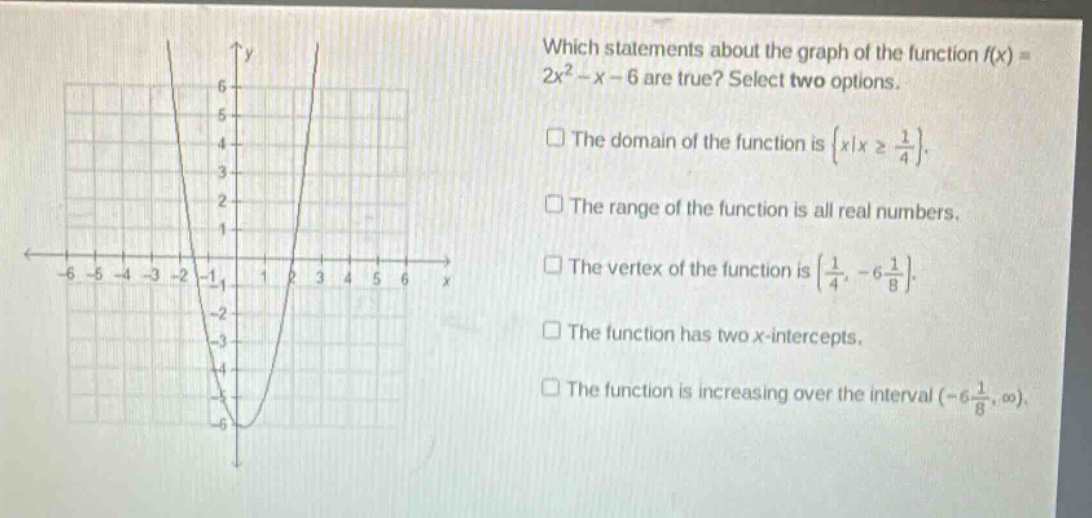
which statements about the graph of the function f(x)=2x² - x - 6 are true? select two options. the domain of the function is {x|x ≥ 1/4}. the range of the function is all real numbers. the vertex of the function is (1/4, -6 1/8). the function has two x - intercepts. the function is increasing over the interval (-6 1/8, ∞).
Answer
Explanation:
Step1: Recall domain of quadratic functions
The domain of a quadratic function $y = ax^{2}+bx + c$ (in this case $a = 2$, $b=-1$, $c = - 6$) is all real - numbers, since we can substitute any real number for $x$. So the statement about the domain $\left{x|x\geq\frac{1}{4}\right}$ is false.
Step2: Recall range of quadratic functions
For a quadratic function $y=ax^{2}+bx + c$, the range is $y\geq y_{vertex}$ if $a>0$ or $y\leq y_{vertex}$ if $a < 0$. First, find the $x$ - coordinate of the vertex using the formula $x=-\frac{b}{2a}$. Here, $x =-\frac{-1}{2\times2}=\frac{1}{4}$. Then find the $y$ - coordinate of the vertex by substituting $x = \frac{1}{4}$ into the function: $y=2(\frac{1}{4})^{2}-\frac{1}{4}-6=2\times\frac{1}{16}-\frac{1}{4}-6=\frac{1}{8}-\frac{2}{8}-6=-6\frac{1}{8}$. Since $a = 2>0$, the range is $y\geq - 6\frac{1}{8}$, not all real numbers, so the statement about the range is false.
Step3: Confirm vertex calculation
We already found that for $y = 2x^{2}-x - 6$, using $x=-\frac{b}{2a}$, $x=\frac{1}{4}$, and substituting $x=\frac{1}{4}$ into the function $y=2(\frac{1}{4})^{2}-\frac{1}{4}-6=\frac{1}{8}-\frac{2}{8}-6=-6\frac{1}{8}$. So the vertex is $(\frac{1}{4},-6\frac{1}{8})$.
Step4: Find x - intercepts
Set $y = 0$, so $2x^{2}-x - 6=0$. Factor the quadratic equation: $2x^{2}-x - 6=(2x + 3)(x - 2)=0$. Then $2x+3 = 0$ gives $x=-\frac{3}{2}$ and $x - 2=0$ gives $x = 2$. So the function has two $x$ - intercepts.
Step5: Determine increasing interval
Since $a = 2>0$, the function is increasing to the right of the vertex. The $x$ - coordinate of the vertex is $x=\frac{1}{4}$, so the function is increasing on the interval $(\frac{1}{4},\infty)$, not $(-6\frac{1}{8},\infty)$.
Answer:
The vertex of the function is $(\frac{1}{4},-6\frac{1}{8})$; The function has two $x$-intercepts.